
|
|
Tuesday, July 21, 2026 · Week of July 13 to July 20 · Strictly nonpartisan
|
|
With the Legislature out until 2027, the agencies and interim boards did the governing this week.
|
|
This week, in one line
Texas's new lottery regulator advanced its first rules restricting ticket couriers and bulk buying; long-term care providers pressed the state for Medicaid rate increases as attendant pay stalls near $13 an hour; the educator board suspended teaching certificates on arrest under a new law; environmental regulators created a utility district over two local governments' objections; the radiation board weighed a federal plan to loosen worker dose limits; and the workforce commission took its docket outside Austin for the first time.
|
|
01 · Gaming
Texas's new lottery regulator advances its first rules targeting couriers
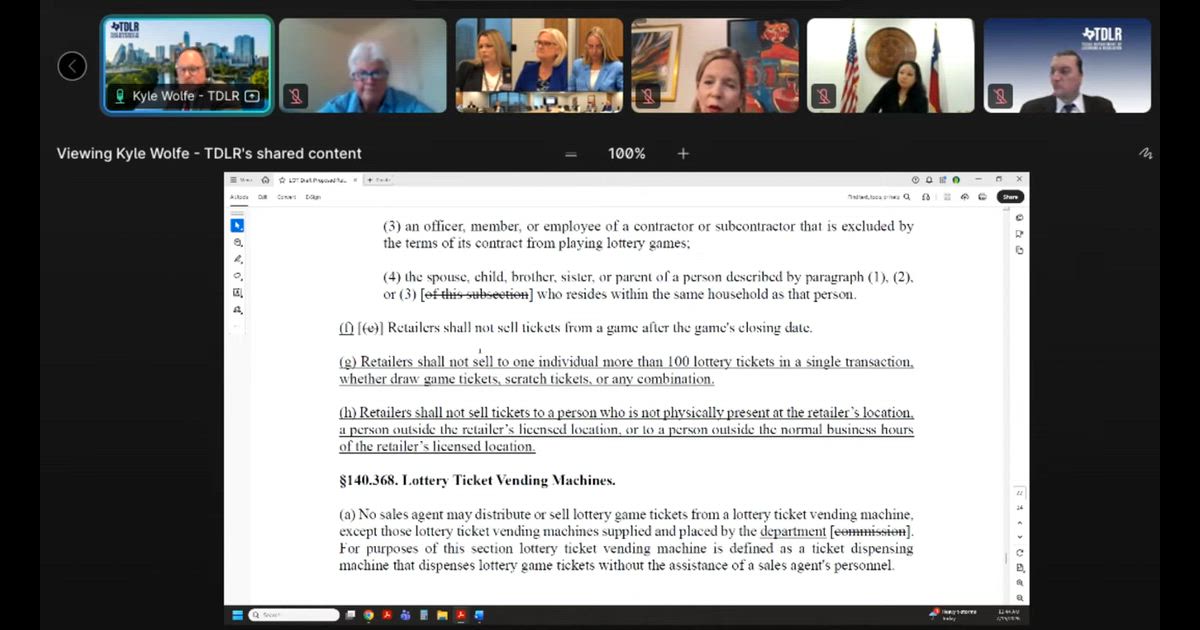
The Texas Lottery Advisory Committee, the panel created when lottery oversight moved to the Texas Department of Licensing and Regulation (TDLR) after the Texas Lottery Commission was abolished, voted 5 to 0 on July 15 to recommend publishing its first package of rules for a 30-day public comment period. The package carries out Senate Bill 1346 and Senate Bill 3070, two measures the Legislature passed in 2025, and through a new rule in Title 16 of the Texas Administrative Code it would bar retailers from selling more than 100 tickets in a single transaction, prohibit sales to anyone a clerk knows is buying "all or substantially all" of the possible winning tickets in a drawing, and forbid taking ticket orders by phone, internet, or mobile app or selling to a person not physically present, the practices used by lottery couriers. Assistant General Counsel Kyle Wolf, who presented the package, said the bulk-purchase ban drew the most attention in the press. Staff acknowledged one gap: there is no system-level control that enforces the 100-ticket limit, so it depends on retailer clerks. The rules would appear in the Texas Register for comment, and staff said they aim for adoption by the full Texas Commission of Licensing and Regulation, chaired by Rick Figueroa, at its October 6, 2026 meeting.
“We've educated our retailers that they cannot sell more than a hundred tickets per transaction per person, but there's not a system limitation that we can implement into the gaming system to prevent it. So it's all communication driven to the retailers to be able to prevent that at the clerk.”
Kelly Stuckey, Lottery Operations Director, TDLR, July 15.
▶ Watch this moment on USLege
Why it matters It is the reconstituted oversight body's first rulemaking since the program moved to TDLR, and it puts the Legislature's response to the courier debate into rule form. Staff's acknowledgment that the 100-ticket cap has no technical enforcement points to a gap between what the rule intends and how it would work at the register.
|
|
02 · Health
Long-term care providers press Texas for Medicaid rate increases
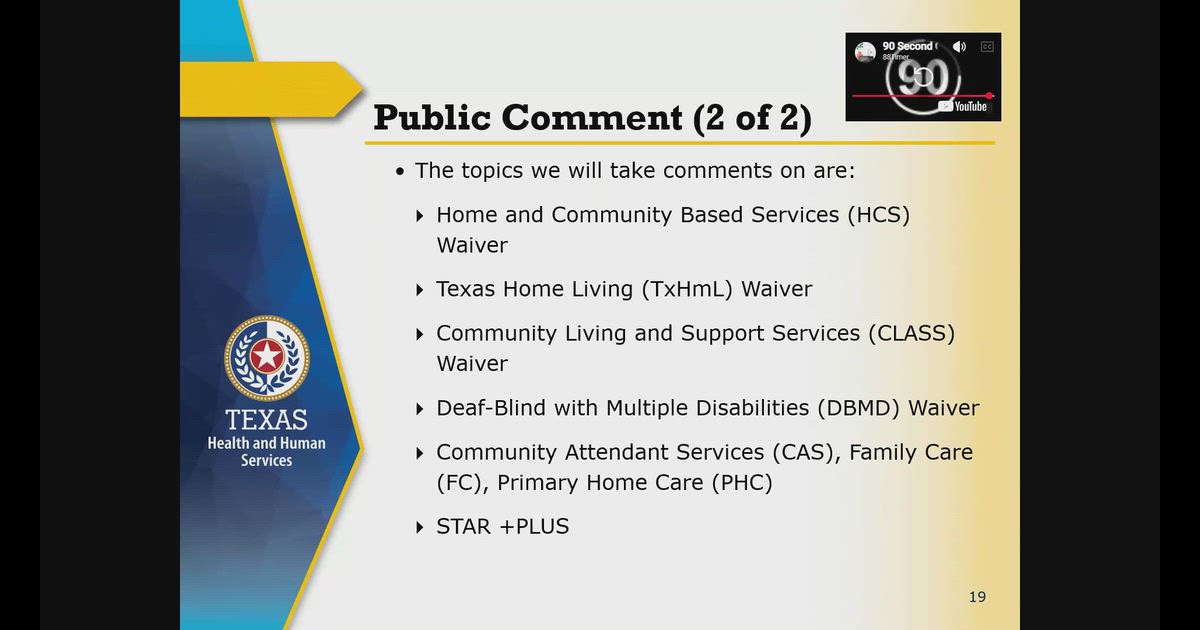
At a July 15 hearing of the Health and Human Services Commission (HHSC) Provider Finance Department, dozens of long-term care providers urged the state to raise Medicaid reimbursement rates under a biennial review of its rate methodology, covering community attendant services, group homes for people with disabilities, assisted living, and pediatric therapy. Emmy Moser, who manages the department's rate research team, took comment; HHSC proposed no rate changes at the hearing, which feeds a possible rate hearing in the first quarter of state fiscal year 2027. Providers testified that the attendant reimbursement rate sits near $13 an hour while state supported living centers, the state-run residential facilities for people with disabilities, pay $17 or more; that pediatric speech-therapy reimbursement fell from $140 a visit in 2010 to $119 in 2026; and that a statewide pediatric-therapy waitlist grew from about 1,975 children in November 2022 to nearly 8,000 by June 2024. Rachel Hammond, executive director of the Texas Association for Home Care and Hospice, said the administrative portion of the attendant rate has risen 24 cents since 2006. Written comments were due July 17, 2026.
“That attendant rate under the current reimbursement for providers methodology is $13 an hour... we're also competing with the state supported living centers that can offer significantly higher wages. That's $17 plus an hour due to their approved higher reimbursement rates.”
Crystal Cantu, Mission Road, July 15.
▶ Watch this moment on USLege
Why it matters The testimony documents a workforce and access strain across Texas Medicaid long-term care. Because the comments feed a possible fiscal year 2027 rate hearing, they preview where provider pressure will concentrate before the next budget cycle.
|
|
03 · Education
Educator board suspends teacher certificates on arrest under new law
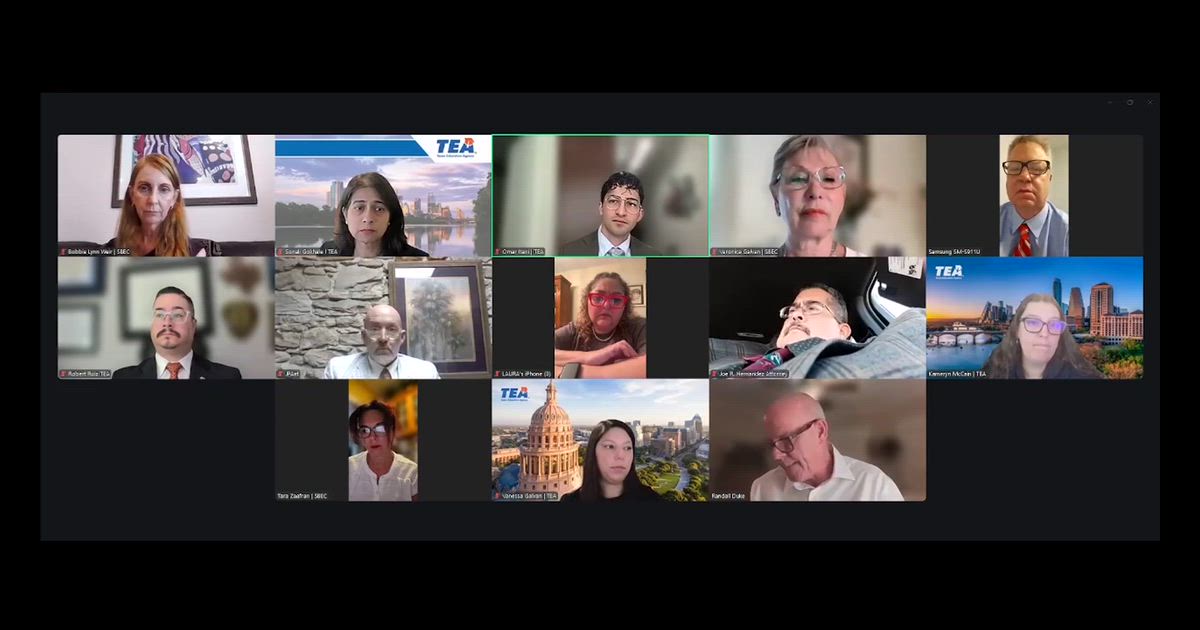
The State Board for Educator Certification's Temporary Suspension Committee, staffed by the Texas Education Agency (TEA), met July 16 and applied Chapter 22A of the Texas Education Code, a 2025 law that requires the temporary suspension of an educator's certificate upon arrest for certain offenses, including felonies under Title 5 of the Penal Code, which covers offenses against the person, and crimes that require sex-offender registration. The committee suspended roughly two dozen certificate holders and said repeatedly that the statute leaves it no discretion once a qualifying arrest is verified against the educator's records. Several defense attorneys, including Joe Hernandez, objected that the law removes the presumption of innocence and provides no evidentiary hearing before suspension, and asked that their objections be entered on the record for the next legislative session. The committee and TEA staff answered that any change to the standard rests with the Legislature, not the board. Every suspension motion carried.
“We in this country have the presumption of innocence. And it seems like it is skewed for some reason that it negates a presumption. And although it is temporary suspension, it's still preventing the individual from working, from employment and for their sustenance of their families and lives.”
Joe Hernandez, attorney representing a certificate holder, July 16.
▶ Watch this moment on USLege
Why it matters Texas now removes teaching credentials at the arrest stage, before any indictment or conviction, which the attorneys argue takes educators out of classrooms on unproven accusations. The objections entered on the record signal a target for legislative changes when lawmakers return.
|
|
04 · Environment
Environmental regulators create a utility district over local objections
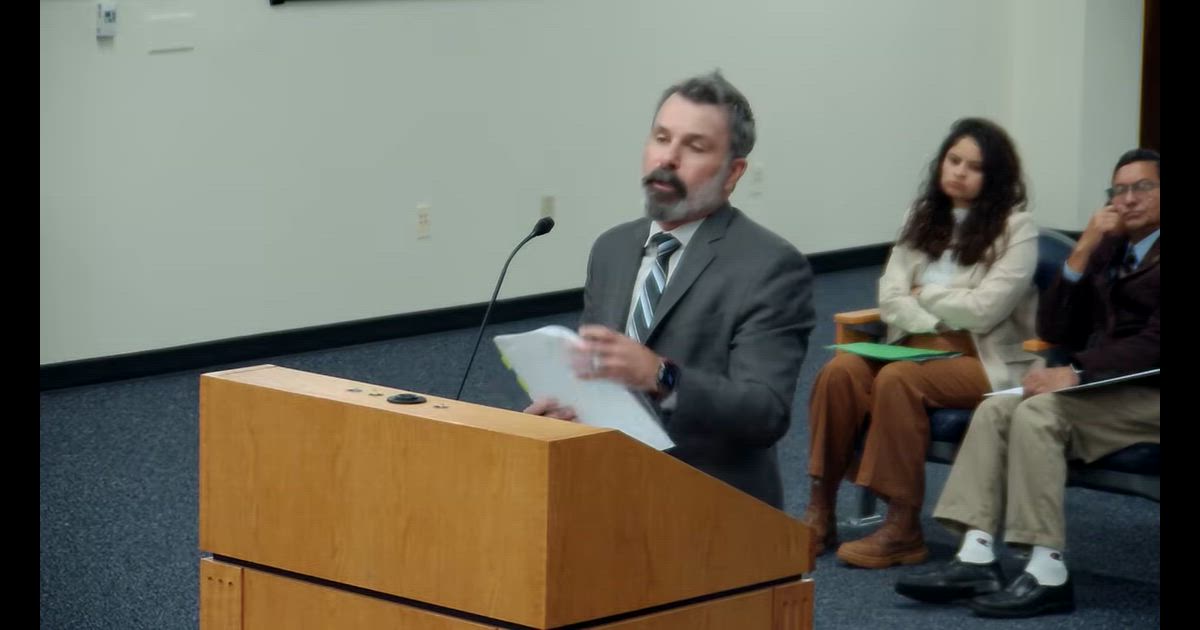
The Texas Commission on Environmental Quality (TCEQ) voted July 15 to grant a petition creating Lakeview Municipal Utility District No. 1 of Ellis County and to authorize the district to build roads. A municipal utility district (MUD) is a local government that can levy taxes and issue debt to pay for water, sewer, and drainage in new development. Ellis County and the City of Waxahachie opposed the district through contested-case counsel, arguing that the developer's preliminary engineering report understated its financing obligation to its water supplier, the Sardis Lone Elm Water Supply Corporation. Petitioner's counsel Brian Moore, of the law firm Coats Rose, answered that the supplier's capital improvement fee is published in its tariff at $7,500 per connection and that the per-connection costs were reasonable. The three-member commission, chaired by Brooke Paup with Commissioners Catarina Gonzales and Tonya Miller, adopted the administrative law judge's proposal for decision, as revised, and granted the petition.
“That capital improvement fee is published, publicly available in Sardis' published tariff. And that capital improvement fee today, as we sit here today, is $7,500 per connection.”
Brian Moore, attorney, Coats Rose, for the petitioners, July 15.
▶ Watch this moment on USLege
Why it matters The decision creates a new taxing entity near Waxahachie despite formal opposition from the affected county and city. The recorded dispute turned on whether the district's true cost to its water supplier was disclosed in the engineering report.
|
|
05 · Energy & Waste
Texas radiation board weighs federal plan to loosen worker dose limits
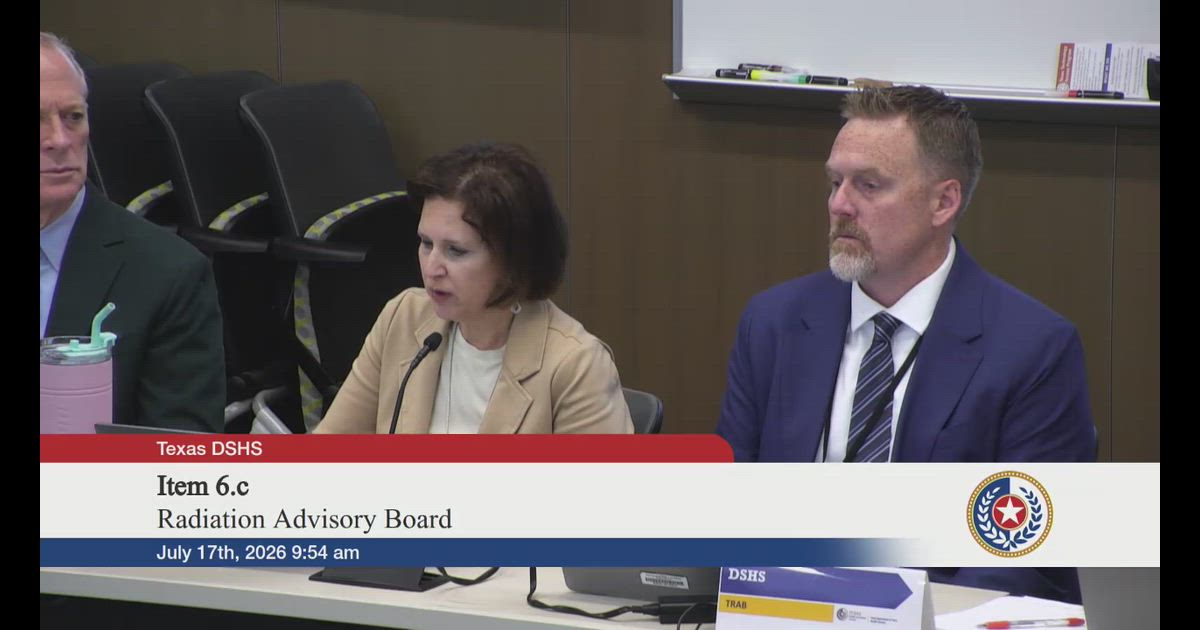
At its July 17 meeting, the Texas Radiation Advisory Board heard the Department of State Health Services (DSHS) brief members on a Nuclear Regulatory Commission (NRC) rulemaking that would change how workers' radiation exposure is limited. DSHS staff said the linear-no-threshold model, which assumes any radiation dose carries some risk, would stay in place, but the "as low as reasonably achievable" standard would be replaced by a graded approach. A new mechanism, the Planned Occupational Dose Limit Extension, would measure a worker's dose over five years and allow an exceedance in a single year, for example 6 rem, a rem being a standard unit of radiation dose, as long as the five-year total stays within 10 rem; the annual limit of 5 rem would remain on the books. DSHS said it plans to file comments before the federal comment period closes August 31, 2026.
“There is a new acronym that they are using for planned occupational dose limit extension. They are calling it PODEL. So what this does essentially is it looks at five years' worth of data for occupational exposure, and as long as you're within 10 rem in those five years, anything you get in any of those years is acceptable.”
Joanne Hartcock, Texas Department of State Health Services, July 17.
▶ Watch this moment on USLege
Why it matters Replacing the "as low as reasonably achievable" standard with multi-year dose averaging would change how occupational radiation exposure is limited for the workers Texas regulates. The state's decision to comment places Texas among the agencies weighing in before the rule takes effect.
|
|
06 · Workforce
Workforce Commission holds first docket meeting outside Austin
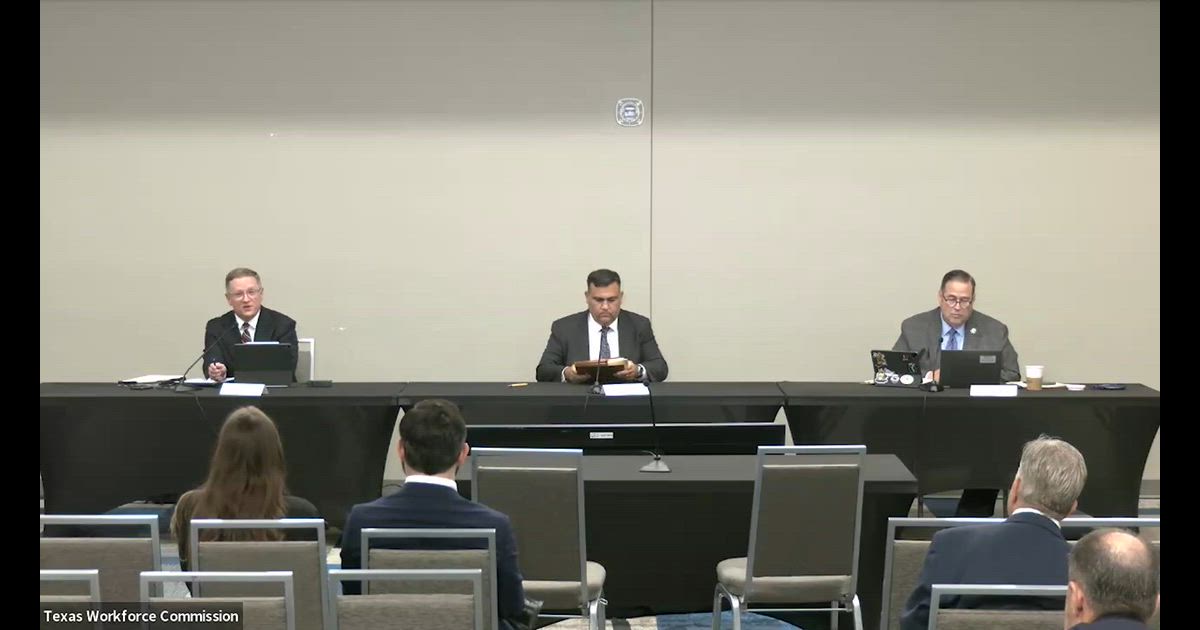
The Texas Workforce Commission (TWC), the state agency that decides unemployment and wage-claim appeals, held its regular docket meeting in Allen on July 15, the first time it has conducted the meeting outside its Austin headquarters. Chairman Joe Esparza opened the session and turned the appeals docket over to Commissioner Brent Connett, who represents the public; Commissioner Alberto Treviño III, who represents labor, also took part. The commissioners decided the usual unemployment-insurance and wage-claim cases and described the Allen meeting as a trial run for holding future meetings around the state. The session was limited to the appeals docket.
“I think it's exciting and important that we can keep up the business of the people while we're outside the city of Austin. So here in Allen or elsewhere, this has been a tremendous trial run, so thanks for your good work.”
Brent Connett, Commissioner Representing the Public, Texas Workforce Commission, July 15.
▶ Watch this moment on USLege
Why it matters Moving the commission's quasi-judicial docket outside Austin is an accessibility change for an agency whose decisions reach employers and unemployment claimants statewide. The commissioners' framing suggests future meetings could rotate to other Texas cities.
|
|
Texas in Washington
|
A federal waste rule Texas is contesting
Alongside the worker-dose rulemaking, Texas agencies are weighing in on a Nuclear Regulatory Commission (NRC) proposal on greater-than-Class-C radioactive waste, a category of low-level waste too radioactive for standard near-surface disposal. At the July 17 Radiation Advisory Board meeting, the Texas Commission on Environmental Quality (TCEQ) reported that the NRC has moved to keep authority over that waste stream rather than share it with the states, and that Texas plans to file comments objecting. Comments are due August 17, 2026, with the NRC expected to finalize the rule in December 2026. The question carries weight in Texas because the state hosts a low-level radioactive waste disposal site in Andrews County.
|
|
|
Also moving this week
At the same July 15 meeting, TCEQ commissioners adopted the agency's enforcement docket, assessing about $1.62 million in administrative penalties across dozens of cases. |
|
|
What we are watching
• Lottery rules: once published, a 30-day comment period; TDLR targets committee adoption October 6, 2026, with a possible interim meeting September 21 to 22, 2026.
• Radiation: NRC worker-dose comments due August 31, 2026; greater-than-Class-C waste comments due August 17, 2026; final rule expected December 2026.
• Medicaid: HHSC's long-term care rate review feeds a possible rate hearing in the first quarter of state fiscal year 2027.
• The Legislature: bill pre-filing for the 90th Texas Legislature opens in November 2026; the session convenes in January 2027.
|
|
What we are tracking
|
How USLege covers the interim
This week's decisions came from boards and commissions rather than lawmakers: a lottery regulator, a Medicaid rate office, an educator-certification panel, an environmental commission, and a radiation board. These meetings rarely make headlines, yet they set the reimbursement rates, licensing rules, and permits that businesses and families live with. USLege transcribes and indexes every one of them, across state agencies, county commissioners courts, city councils, and school boards, so a rule change surfaced in a Tuesday hearing does not wait for a session to be noticed. That is the record this newsletter is built on.
|
|
|
USLege news

USLege at Texas DIR's AI Day
USLege was selected as a vendor for the Texas Department of Information Resources (DIR) AI Day, where state agencies evaluate approved artificial-intelligence tools for government use.
|
|
|
Get your state's weekly read
The Political Spotlight publishes weekly editions for Texas, Washington, New York, and California, with more states rolling out.
|
|
|
|
|
|
USLege Texas Newsletter · Strictly nonpartisan
uslege.ai · About · Forward
An independent publication of USLege, Inc., not affiliated with any government agency.
© 2026 USLege, Inc. · USLege, PO Box 684356, Austin TX 78705
Reply to [email protected]
|
|