
Texas Political Spotlight
Your weekly read on everything Texas government did this week, from the statehouse to Washington to the agencies, commissions, and county courthouses, with every quote and number traced to the public record.
Issue 25 · Tuesday, June 16, 2026 · Week of June 8 to June 15 · Strictly nonpartisan
Coming up: co-founder Laura Davis speaks at the NCSL Legislative Summit, Chicago, July 27 to 29.
|
|
|
This week, in one line
“I’m hearing a lot of my fellow producers say I’m not going to report if I get it. Please report it.”
Caldwell County Judge Hoppe Hayden, a cattle producer, on the New World Screwworm threat, June 12.
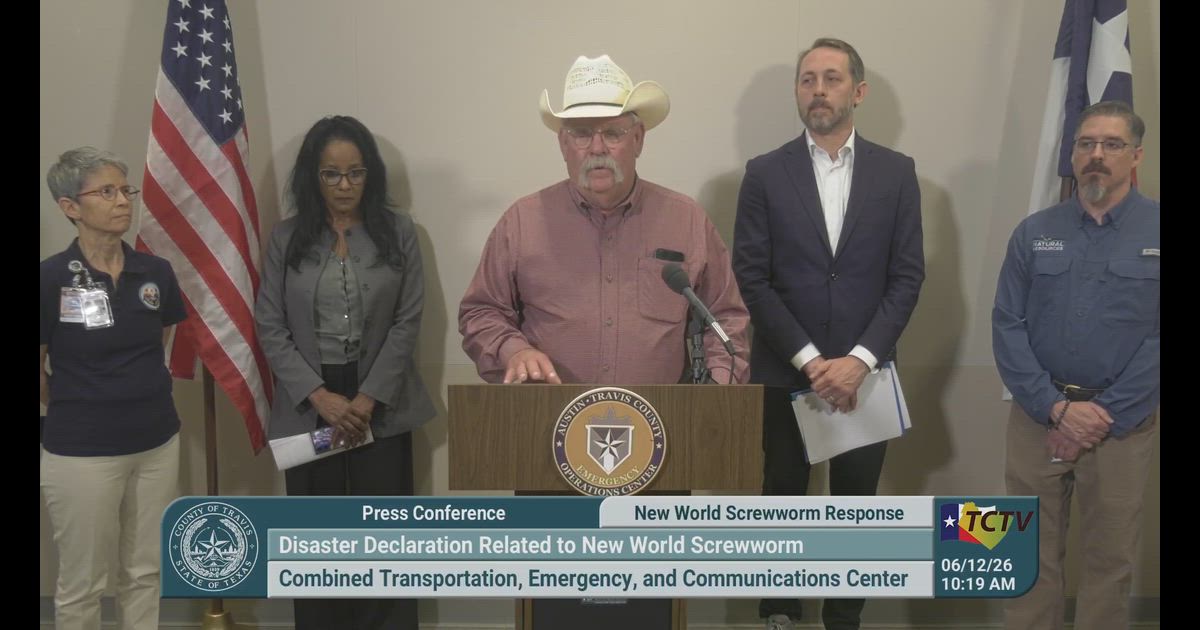
▶ Watch this moment · 0:45 on USLege
|
|
|
01 · Agriculture & animal health
Two Central Texas counties declare disaster over a flesh-eating fly
At a joint press conference on June 12, Travis County Judge Andy Brown signed a local disaster declaration over the threat of the New World Screwworm, a parasitic fly whose larvae feed on the living tissue of livestock, wildlife, pets, and, in rare cases, people. Caldwell County Judge Hoppe Hayden signed a parallel declaration for his county. Both judges stressed there are no confirmed cases in either county and none in Texas native wildlife to date. The declarations are proactive: they let counties shorten purchasing timelines (for example, quickly hiring veterinarians), raise public awareness, and, if a federal declaration follows, open a path to reimbursement. Governor Greg Abbott issued a statewide screwworm disaster declaration in late January and expanded it on June 5, days after the state’s first confirmed case in decades, a calf in Zavala County.
“Today, I’m signing a local disaster declaration for Travis County related to the threat of New World Screwworm.”
Travis County Judge Andy Brown, June 12.
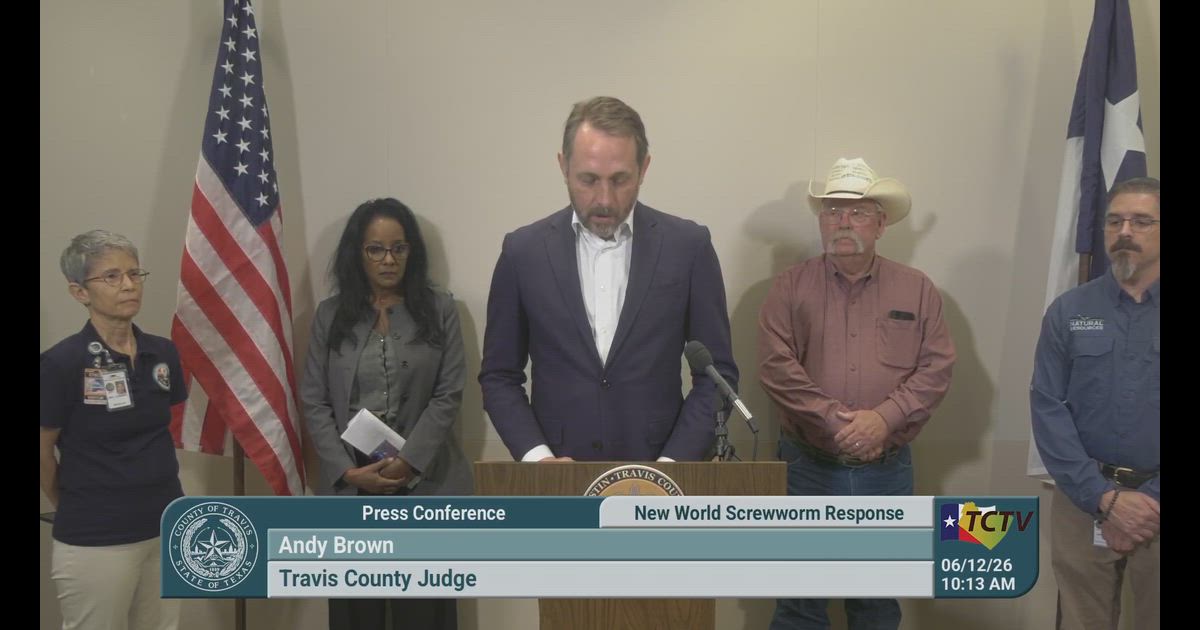
▶ Watch this moment · 0:43 on USLege
Why it matters
The screwworm was eradicated from the United States decades ago using sterilized flies, and officials described a federal and state effort now rebuilding that capacity, including a sterilized-fly production facility under construction in Edinburg. Judge Hayden, a cattle producer, made the week’s sharpest point: some ranchers have told him they will not report cases, and he urged them to report to the Texas Animal Health Commission so the spread can be tracked. Wildlife cases go to Texas Parks and Wildlife; suspected human cases go to a doctor and the Department of State Health Services lab.
|
|
|
02 · Justice & budget
The state pays under 10% of the right to a lawyer. Counties want that changed.
The Texas Indigent Defense Commission (TIDC) met June 12 to assemble its 2028 to 2029 Legislative Appropriations Request (LAR), the budget ask state agencies send to the Legislative Budget Board (LBB) before each session. Staff laid out a slate of “exceptional items” (requests above the base budget) totaling roughly $165 million to more than $242 million for the two-year period, and the board took them up one at a time. The framing number: in fiscal year 2023, Texas spent about $414 million on adult criminal and juvenile indigent defense, of which the state, through TIDC, funded 9.62%. Counties paid the rest. On family and child-welfare representation, counties spent roughly $63 million and the state spent zero. Research presented to the board found Texas has lost more than 1,600 indigent-defense lawyers since 2014, and that 240 counties exceeded the commission’s caseload guidelines in fiscal 2024.
“35 of our 50 states primarily fund public defense at the state level. We are an exception. TIDC funds only 10% of public defense costs.”
Jeff Burkhart, former TIDC executive director, now with Travis County, addressing the board.
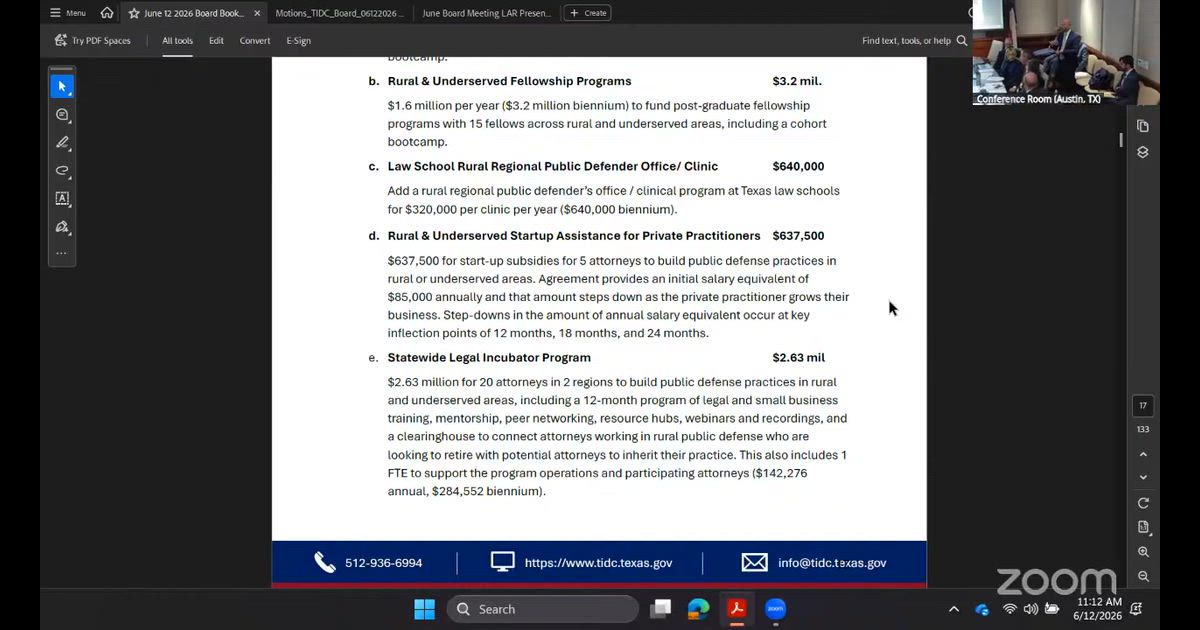
▶ Watch this moment · 0:51 on USLege
Why it matters
County officials are pushing the funding split toward the state. Rick Thompson of the County Judges and Commissioners Association told the board the 3.5% property-tax voter-approval cap is “crowding out” county services, and asked the state to move toward a 50/50 partnership. The board also voted to add an exceptional item that would redirect leftover Operation Lone Star (OLS) funds, currently $41 million per biennium, into TIDC’s base budget for unrestricted county grants if the LBB strips that money out. The Fair Defense Act, the 2001 law behind the system, turns 25 this year, and the commission plans to use the anniversary to press its case in 2027.
|
|
|
03 · Public safety
Public Safety to lawmakers: cities are out-paying us for troopers
At the June 11 Public Safety Commission meeting, the Texas Department of Public Safety (DPS) signaled it will ask the 2027 Legislature for trooper pay increases, citing a widening recruiting gap with city and federal agencies. Lieutenant Colonel Walt Goodson reported that DPS expects to bring on roughly 740 officers across the 2025 to 2026 period, a record pace, but that recruit-class sizes are falling from an average of 124 to about 65. He attributed the drop to pay: the State Auditor’s benchmark report, due in November before the session, is expected to show DPS well into double digits behind the agencies it competes with. Separately, leaders said the ballistic windshield and door-glass program, born after troopers were shot through patrol-car windshields in 2021 and funded at about $22 million initially with $12.8 million per biennium since, is now nearly 100% deployed across the fleet.
“The Houston Police Department received a 36 and a half percent pay raise. Harris County has parity with HPD, and we’ve seen a strong slippage in recruiting specifically out of the Houston area.”
Lt. Col. Walt Goodson, Texas DPS, June 11.
▶ Watch this moment · 0:43 on USLege
Why it matters
DPS is hiring at a near-record clip and still losing the competition for officers, and commissioners endorsed taking a salary request to the Legislature. The agency also told the commission that multi-year city contracts will widen the gap year over year unless the state responds, setting up a trooper-pay line item as one of the early budget fights of the 2027 session.
|
|
|
04 · Workforce & families
Texas cuts a $25M child-care expansion to shrink the subsidy waitlist
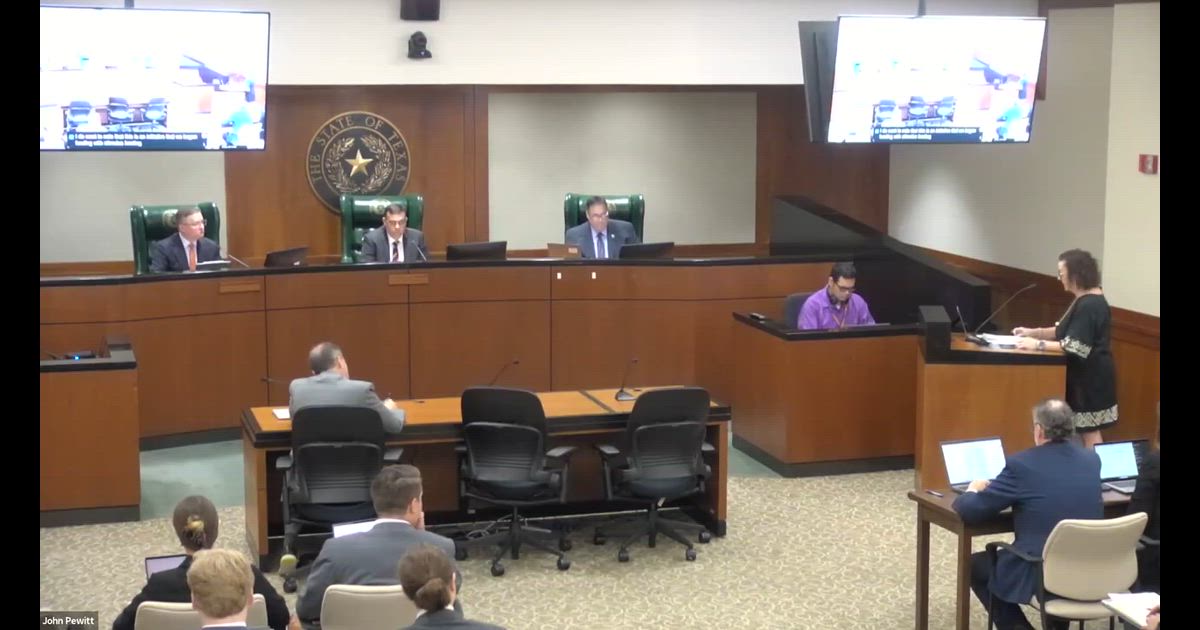
The three-member Texas Workforce Commission (TWC) voted June 9 to move child-care dollars away from statewide “quality” initiatives and toward direct subsidies, citing a long child-care assistance waiting list. Staff recommended discontinuing the $25 million child-care expansion approved for fiscal 2026; because the money had not yet been awarded, TWC will terminate the open procurement. A separate staff-retention grant was also dropped for lack of turnover data. The expansion began with pandemic stimulus funding, and staff said the outcomes “are not what we hoped.” Revised board allocations and performance targets return in mid-July.
“Given our very large waiting list, we believe that prioritizing these funds to support more children in care is appropriate.”
Reagan Miller, TWC child care and early learning division, June 9.
▶ Watch this moment · 0:40 on USLege
Why it matters
The vote resets a trade-off providers and advocates will track all year: fewer dollars for building child-care supply, more for subsidizing families already in line. In the same meeting, TWC approved sending $3,108,441 in federal Reemployment Services and Eligibility Assessment (RESEA) performance payments to local boards, and adopted rules implementing House Bill 3260, the 89th Legislature’s industry-recognized apprenticeship grant program.
|
|
|
05 · Transportation & consumers
Texas auto thefts fell 24% in a year, as the motor-vehicle agency lines up 2027 asks
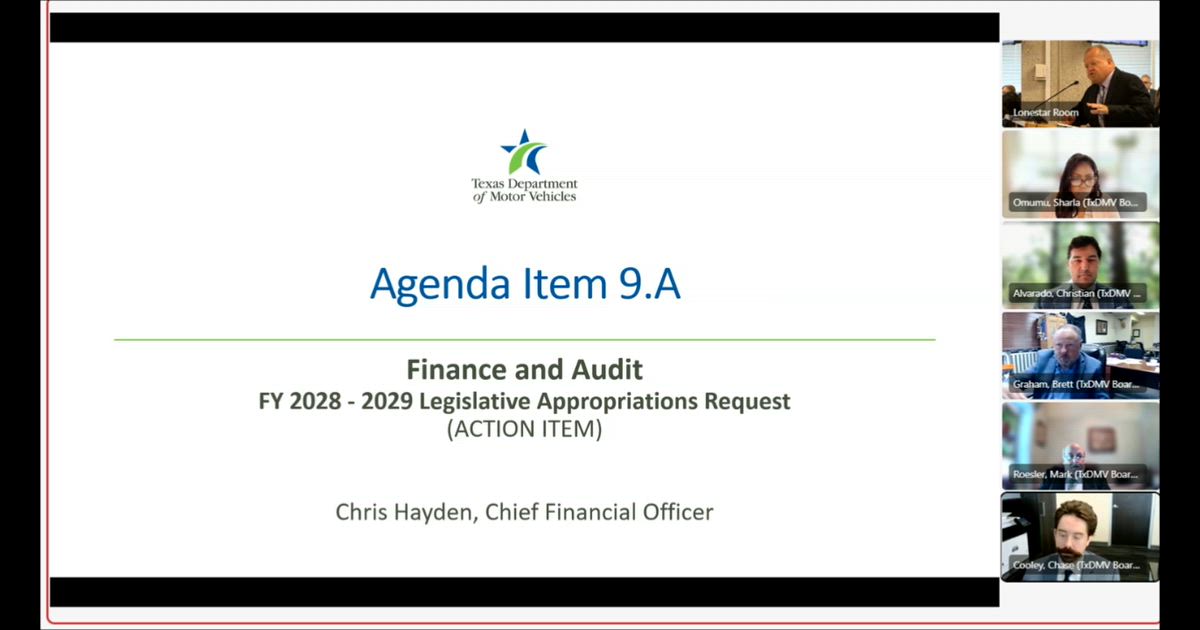
The Texas Department of Motor Vehicles (TxDMV) board met June 11 to set its 2028 to 2029 budget direction and move two rule packages to public comment. The headline number came from the Motor Vehicle Crime Prevention Authority (MVCPA): Texas motor-vehicle thefts fell from about 103,000 in calendar 2024 to just over 70,000 in calendar 2025, roughly a 24% drop, broadly tracking a national trend. The agency’s lone budget exceptional item is authority for seven added staff for the crime-prevention unit, funded within existing money. Staff will again ask lawmakers to raise the statutory salary ceiling for the agency’s executive director to a maximum of $268,900, a change that would not raise appropriations, and will seek authority to keep spending the $125 million registration-and-titling modernization appropriation from the 89th session.
“We’ve gone from 103,000 plus motor vehicle thefts in Texas in calendar ’24 to just over 70,000 motor vehicle thefts in the state in calendar year ’25.”
William Diggs, director, Motor Vehicle Crime Prevention Authority, June 11.
▶ Watch this moment · 0:39 on USLege
Why it matters
For operators, the rule packages carry the practical changes: the proposed Chapter 217 amendments would let owners register trailers of 7,500 pounds or less for one to five years and reflect the move from paper E-tags to E-plates set in House Bill 718, while Chapter 218 would require sole proprietors to provide a Social Security number per a recent attorney general opinion. Both went out for public comment, so the next step is the comment window before adoption.
|
|
|
06 · Environment
State environmental regulators name 2026 excellence honorees
The Texas Commission on Environmental Quality (TCEQ) posted its 2026 Texas Environmental Excellence Award winners, the state’s top environmental honors. This year’s recipients span the state and include PepsiCo Global Concentrate Solutions (pollution prevention), Austin Youth River Watch (education), Austin FC and Q2 Stadium (innovative operations), Texas Disposal Systems (technical and technology), Katie Lewis of Texas A&M AgriLife Research (agriculture), the City of Snyder and Keep Snyder Beautiful (civic and community), and the Coppell High School Eco Club (youth). Erica Villarreal of Channelview High School was named Environmental Educator of the Year.
|
|
|
Texas in Washington
|
Congress spent the week marking up fiscal year 2027 spending bills (Homeland Security and the Labor, Health and Human Services, and Education bill) and the National Defense Authorization Act (NDAA, the annual defense policy bill), but the federal action that lands hardest in Texas was final. President Trump signed the Secure America Act (S. 2), the border and immigration enforcement law, on June 10. It directs roughly $69.5 billion to Immigration and Customs Enforcement (ICE) and Customs and Border Protection (CBP) through fiscal 2029, including funding for 287(g) agreements, the program that lets state and local police enforce federal immigration law.
That connects straight to this week’s Texas record: the Department of Public Safety told its commission it already operates under a 287(g) agreement and continues Operation Lone Star, even as state officials weigh redirecting leftover border dollars to other needs. The Senate passed S. 2 by 52 to 47 on June 5; the House, 214 to 212 on June 9.
The other Texas-to-Washington thread is in our lead story: the sterilized-fly facility rising in Edinburg to fight the screwworm is a joint federal and state project with the U.S. Department of Agriculture.
|
|
|
|
Also moving this week
|
The 3.5% squeeze. The property-tax voter-approval cap surfaced as the week’s connective tissue, with county officials telling TIDC it is forcing trade-offs among indigent defense, indigent health care, and roads.
Rulemaking season. With the Legislature out of session, agencies pushed packages to the Texas Register: TxDMV (Chapters 217 and 218) and TWC (Chapters 800, 806, and 838), several citing the state’s push to repeal redundant rules.
Public-health committees. Texas Health and Human Services convened several statewide bodies, including the Task Force of Border Health Officials and the Statewide Interagency Aging Services Coordination Council.
Budget and bond season. Districts statewide (Sherman’s two-day budget workshop, Garland ISD facilities and bonds, Houston ISD) worked the local fiscal cycle that runs parallel to the state’s.
ApplyTexas modernization. The Higher Education Coordinating Board’s ApplyTexas committee reviewed system releases that touch every college applicant, including fixes to first-generation-student data.
The Operation Lone Star money question. TIDC is asking the Legislature, through its budget request, to let leftover Operation Lone Star funds it expects to go unspent be redirected into unrestricted county indigent-defense grants. That decision rests with the Legislative Budget Board and lawmakers, not the agency. DPS, separately, is shifting its operational posture toward repeat-offender task forces. Neither agency can move the appropriated dollars on its own.
|
|
|
What we are watching
The Legislative Budget Board’s base-budget policy letter is expected within a week or two; it will determine how much of TIDC’s and other agencies’ Operation Lone Star money survives in the base. Watch the Texas Register for the TxDMV and TWC comment windows, the State Auditor’s November pay-benchmark report behind the DPS trooper-pay ask, and whether more counties follow Travis and Caldwell with screwworm disaster declarations.
|
|
|
From Laura’s desk · AI this week
|
Courts are getting comfortable with AI. Your compliance team should too.
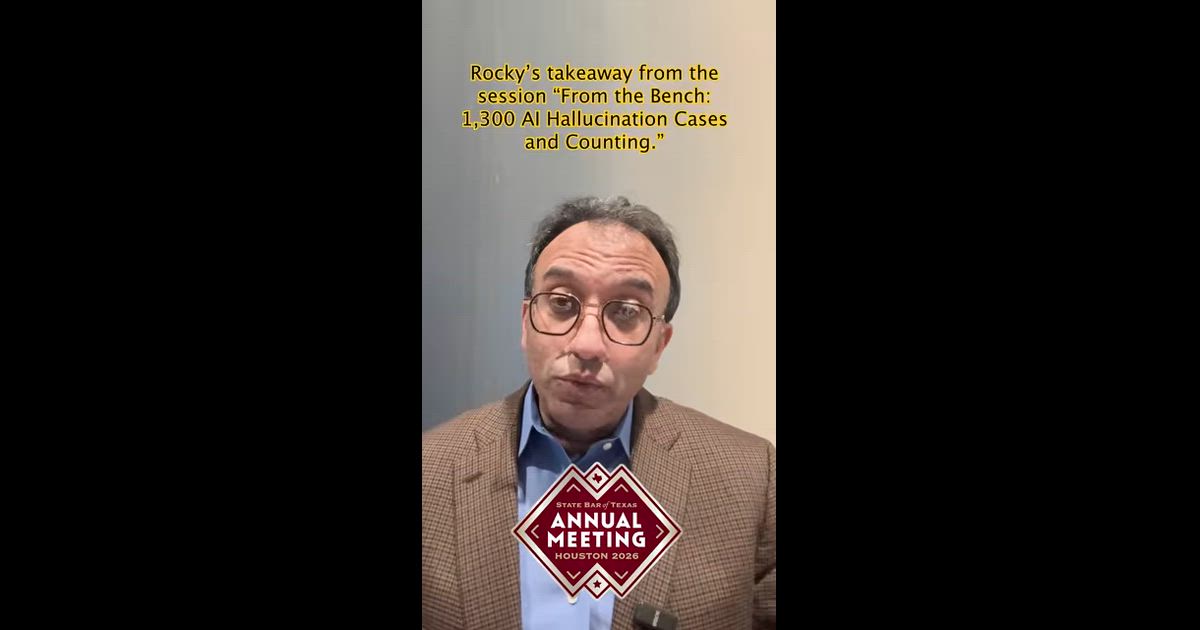
The AI signal this week did not come from a committee room, it came from a ballroom. At the State Bar of Texas annual meeting in Houston, a panel of judges took up artificial intelligence (AI) hallucinations in legal filings, in a session titled “1,300 AI Hallucination Cases and Counting.” The takeaway was not a crackdown: the judges said an unintentional, flagged, and corrected AI error is not sanctionable, it is the cost of working “in a new age.” That is the tell for the government-affairs and compliance teams we build for. The institutions that regulate our customers are shifting from “should we use AI” to “how do we use it responsibly,” and fast. The edge over the next two years goes to teams that already treat AI-assisted research as table stakes, with a human check on every citation and every claim traceable back to the record.
▶ Watch this moment · 1:00 on USLege
Curated by Laura Davis, Co-Founder & CBO, USLege
|
|
|
On the road
Catch me at the NCSL Legislative Summit
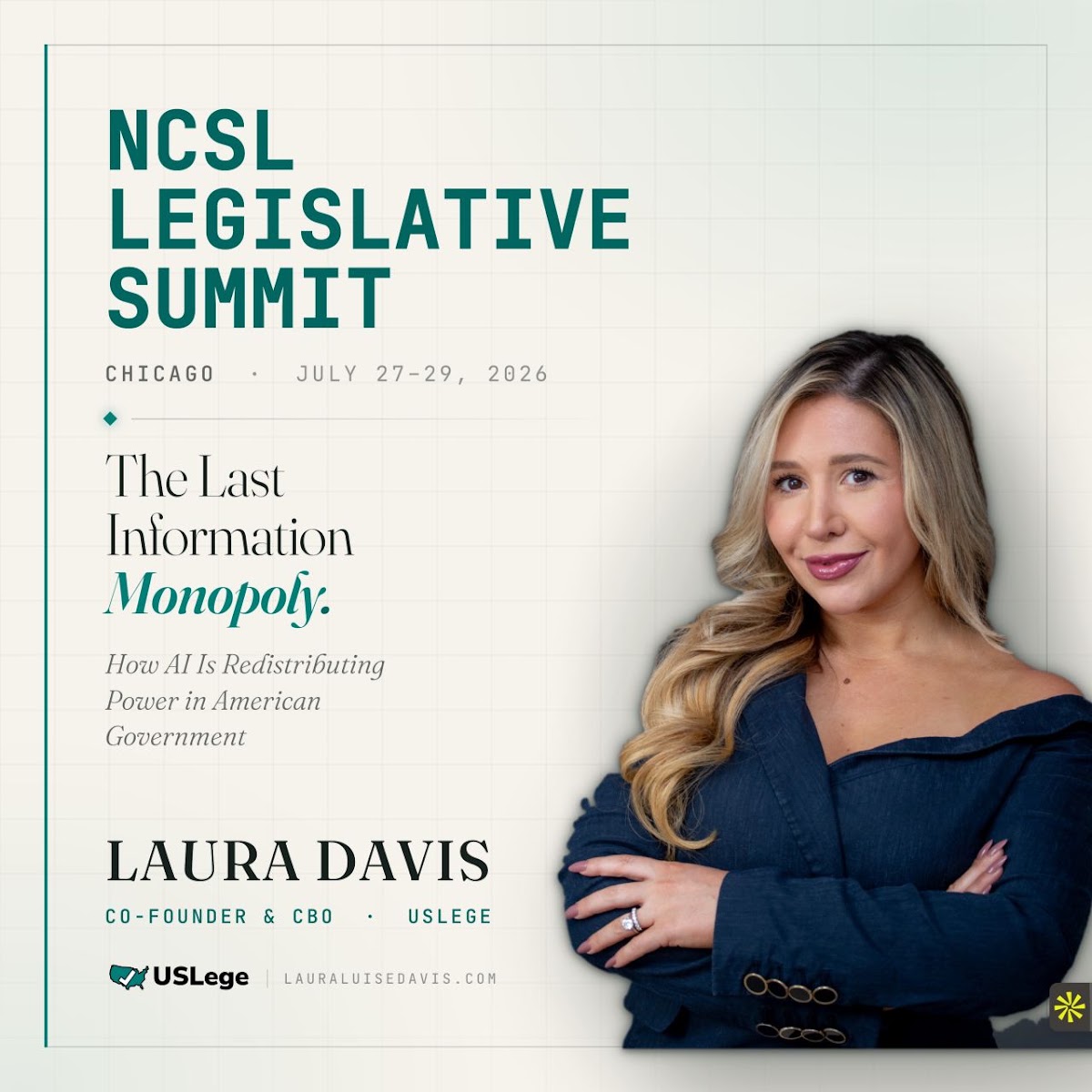
I will be speaking at the National Conference of State Legislatures (NCSL) Legislative Summit in Chicago, July 27 to 29. My session is “The Last Information Monopoly: How AI Is Redistributing Power in American Government.” If you will be there, grab a 30-minute meeting with me and let us talk legislative and regulatory intelligence. And if you just need help putting USLege to work for your team, we are here and ready to meet.
Laura Davis · Co-Founder & CBO, USLege
|
|
|
|
Hackathon

Come vote on our team, American Idol style
Join us for BBQ and vote on our newest features, demo by demo, American Idol style. We are heads-down building what you have been asking for, and the room decides what ships next. RSVP through the invite below.
|
|
|
|
|
|
Texas Political Spotlight · Strictly nonpartisan
© 2026 USLege, Inc.
|
|