 | Tuesday, August 18, 2026 · Week of August 10 to August 15 · Strictly nonpartisan | A week of interim hearings and agency dockets set out what the next Legislature will be asked to pass. | Correction Our August 11 issue misattributed a quote from the Texas Windstorm Insurance Association’s August 4 board meeting to “Carolyn.” The board member who spoke is Terrilyn Tarlton Shannon. We regret the error. |
| This week, in one line State police cited estimates putting cartel fuel trafficking at $12 billion to $21 billion a year and asked to end overweight permits for hazardous loads; a senator and two House members asked utility regulators to deny the Permian Basin’s 765 kilovolt lines over landowner notice; the chairman of the Railroad Commission, which regulates oil and gas rather than railroads, said no final produced water permit has issued in nearly three years; the Sunset Advisory Commission opened its Texas Workforce Commission review and set a September 29, 2026 deadline for changes; environmental regulators postponed a water district’s petition for want of proof that notice was published and approved $2.07 million in penalties; the Water Development Board asked for 64 positions, 50 of them to prepare for Proposition 4 water money that starts flowing in 2027; and a witness put federal counter-drone certifications at 61 officers nationwide. | | 01 · Border security State Police Asked Senators to End Overweight Permits for Hazardous Loads, Citing a $12 Billion to $21 Billion Fuel Trade Cartel fuel trafficking runs $12 billion to $21 billion a year on recent estimates, and some federal partners now believe it has passed narcotics as the cartels’ largest revenue source, the Texas Department of Public Safety (DPS) told the Texas Senate Select Committee on Homeland and Border Security on August 13, 2026. DPS also cited Financial Crimes Enforcement Network figures showing United States banks flagged more than $7 billion in suspicious cartel-linked fuel transactions over a 14-month period. The committee took three interim charges together at the August 13 hearing: securing Texas land ports of entry, criminal activity on oversize and overweight truck routes, and the integrity of export fuel. Witnesses walked the committee through the mechanics. Empty Mexican trucks cross, buy tax-free export fuel at a licensed terminal, buy an online overweight permit good to 125,000 pounds, then leave the permitted route for what DPS calls a clandestine fuel site, where the load is blended down with cheaper product and overloaded by another 20,000 to 40,000 pounds. Asked by Sen. Bob Hall what could be done fastest, without waiting for a session, Maj. Omar Villarreal of DPS named a single change.
“I would recommend eliminating the authorization for an overweight permit for those carrying hazardous materials.”
Maj. Omar Villarreal, Texas Department of Public Safety, August 13. 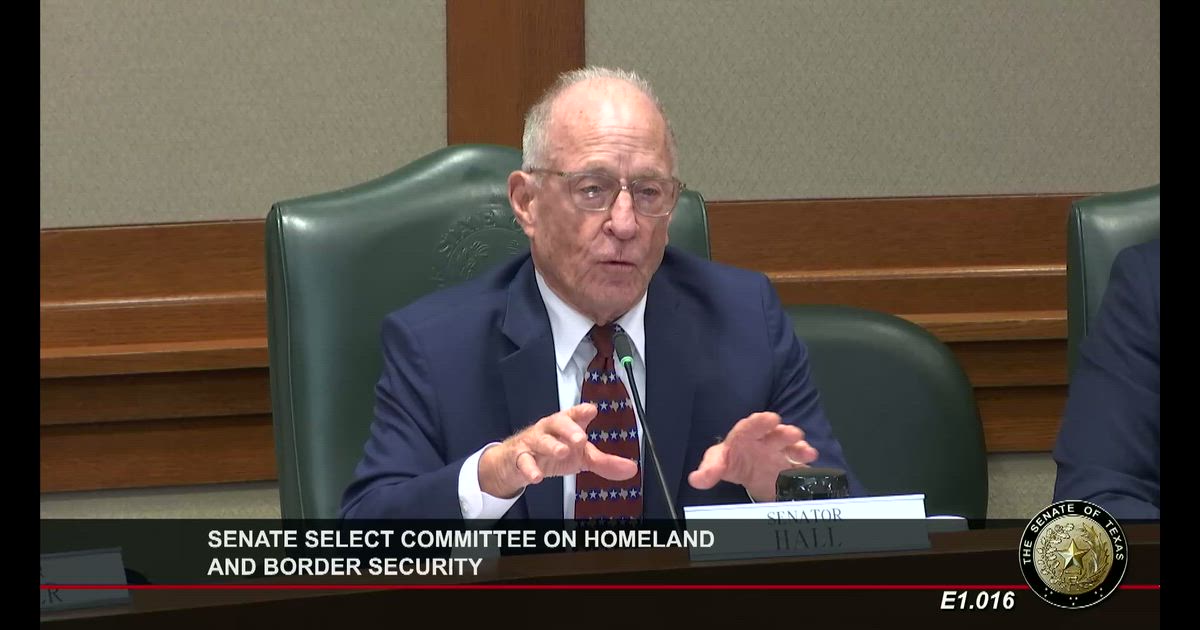 ▶ Watch this moment on USLege Three different fixes ended up on the table. The Texas Trucking Association endorsed capping hazardous loads at 80,000 pounds, the standard legal weight limit. Sen. Juan “Chuy” Hinojosa, the committee’s vice chair, pressed a third approach: outlaw the depots outright and make route deviation a felony, the substance of his SB 2949 from the 2025 session, which would have barred motor fuel depots in counties bordering Mexico and made it a second-degree felony to move a three-axle overweight vehicle carrying hazardous materials off its permitted route. It passed the Senate 31 to 0 and never reached a vote in the House. The two agencies that issue the permits raised objections. A Texas Department of Transportation (TxDOT) witness said an 80,000-pound cap could put more trucks on the road. A Texas Department of Motor Vehicles witness warned of consequences for loads such as nuclear waste casks that move under existing permits. Hinojosa rejected the more-trucks argument, saying overweight corridors exist essentially only at the border. Asked whether the agency could refuse an overweight permit based on the cargo, the TxDOT witness said the statute is silent on commodity and reads as broad and open, and that she would have to put the question to the agency’s lawyers. One statutory question went unresolved. Hinojosa argued that moving tax-exempt export fuel between containers at a depot is already a second-degree felony, because it diverts the load from its designated destination. A lieutenant with the Comptroller’s Criminal Investigation Division said the agency’s tax policy office has advised that if the fuel is ultimately exported, the transfer is neither taxable nor criminal. Hinojosa said he does not read the statute that way. The lieutenant agreed to take it back to tax policy, and Sen. Tan Parker asked for a formal review. That division has 50 peace officers statewide. Why it matters Three fixes are on the table and only one is narrow: end the overweight permit for hazardous loads, cap those loads at 80,000 pounds, or make leaving the permitted route its own offense. The two agencies that issue the permits are not aligned with any of them. And whether the conduct is already a felony is in open dispute between the committee’s vice chair and the Comptroller’s office, which is the kind of disagreement a bill has to settle before it can pass. |
| | 02 · Grid and land Three Legislators Asked the Public Utility Commission to Deny the Permian Basin’s 765 Kilovolt Lines Not one member of the public who signed up to speak at the Public Utility Commission of Texas (PUCT) open meeting on August 14, 2026 supported proceeding with the Permian Basin’s 765 kilovolt transmission applications on the current schedule. Sen. Kevin Sparks, Rep. Brad Buckley, Rep. Shelby Slawson, a county commissioner and roughly 20 landowners and organization representatives, among them the Texas Public Policy Foundation and the Hill Country Land and Legacy Alliance, asked the commission to deny the pending applications or pause them until the Legislature has taken up the issue in 2027. Sparks said the state should not condemn private land before it has tried to make local generation attractive. He disclosed that he runs an oil and gas company producing about 20,000 barrels of oil equivalent a day in the region the lines would serve. The dominant complaint was notice. Each project needs a certificate of convenience and necessity, or CCN, which is the state’s permission to build a line and, where negotiation fails, to condemn the land it crosses. Buckley, who owns land in Bell County, gave the specific count.
“In Bell County alone, more than 1,400 parcels and more than 2,000 owners were notified less than thirty days prior to the deadline if they were notified at all. There is no more important reason to deny the applications for CCN than this fact alone.”
Rep. Brad Buckley, Texas House District 54, August 14. 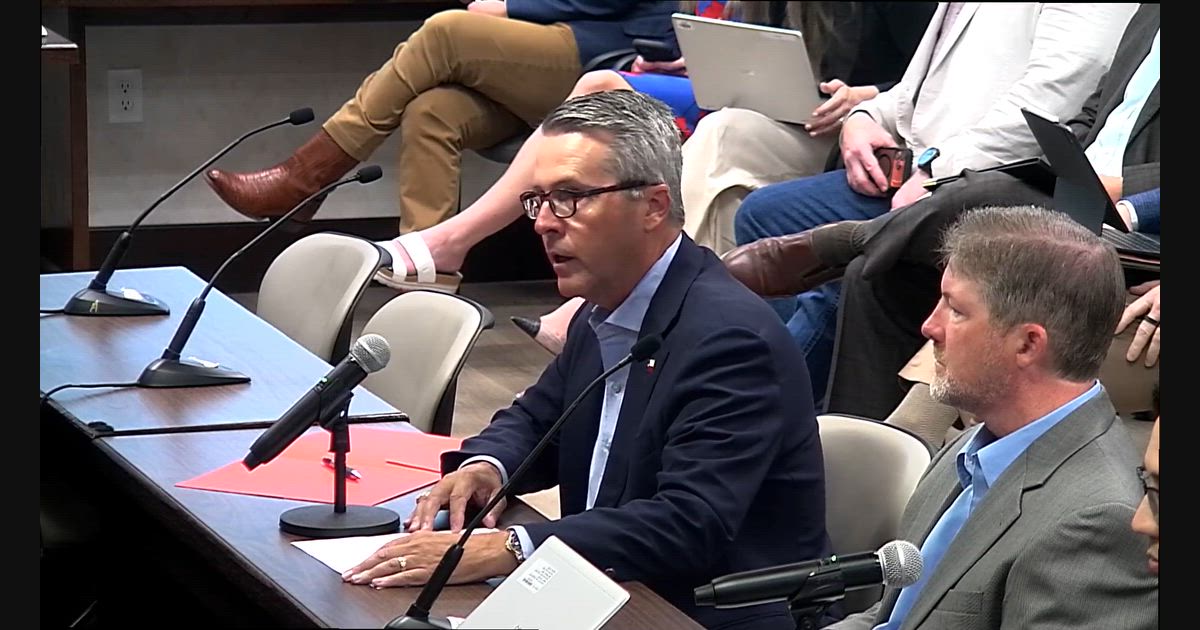 ▶ Watch this moment on USLege A Val Verde County landowner pointed the commission to a motion filed with it on August 11, 2026 arguing that the Permian dockets are not separate projects but interconnected components of a much larger 765 kilovolt system that could ultimately extend across the state, and that once billions of dollars are committed each approval makes the next one harder to reconsider. Both legislators also argued the underlying plan is wrong on generation. Sparks said the Permian Basin Reliability Plan does not address the region’s need for local baseload generation and blamed market signals shaped by federal wind and solar subsidies. Buckley described the project as reflecting continued reliance on renewable generation over dispatchable generation. A landowner appearing without counsel asked for three procedural changes that would need no new legislation: that applicants certify every route segment was covered by the public meeting notice, that landowners get an individual warning and a short chance to cure before losing party status in a docket, and that each docket carry one plain-language calendar of the deadlines that actually control it. Chairman Thomas J. Gleeson said, citing a pre-meeting memo, that no decisions would be made that day, and commission counsel instead laid out where each docket stands. In Docket No. 59029, Oncor Electric Delivery Company’s application covering ten West Texas counties, administrative law judges filed a proposal for decision on May 12, 2026. Docket No. 59336 is the joint application of AEP Texas and CPS Energy for the Howard to Solstice line. Docket No. 59475, the Bell County docket Buckley was describing, is a joint Oncor and Lower Colorado River Authority Transmission Services Corporation application running from Bell County East Switch to the Big Hill Substation, and no proposal for decision has been filed in it. Later in the same meeting, on a separate agenda item about the Governor’s large-load audit, ERCOT witnesses set out the case for the buildout. They described the July 2024 Permian Basin Reliability Plan, the 2024 regional transmission plan and a rolling five-year plan, and told the commissioners that across those studies, including scenarios run at substantially lower load, the recommended transmission, or something equivalent to it, was needed to serve load and that without it the region would have reliability problems. No applicant utility addressed the pending applications, which are contested cases the commission does not take public comment on. Why it matters The chairman said no decisions would come that day, so this week’s objections are not a vote that was lost. They are the record. Notice defects raised now are what a landowner takes to court later, and the three procedural changes offered are ones the commission could adopt on its own. Sitting legislators appearing as witnesses before an agency they oversee is also a signal about what the 2027 session will take up. |
| | 03 · Oil, gas and water The Railroad Commission’s Chairman Told Senators No Final Produced Water Permit Has Issued in Nearly Three Years The Texas Commission on Environmental Quality (TCEQ) began reviewing produced water discharge applications under its own federally approved rules nearly three years ago and has issued no final permit on any of them, Jim Wright, chairman of the Railroad Commission of Texas, which regulates oil and gas rather than railroads, told the Senate Committee on Natural Resources on August 11, 2026. Produced water is the salty water that comes up the well alongside oil and gas. TCEQ has reissued two produced water discharge permits first issued by the Railroad Commission and the federal Environmental Protection Agency (EPA), which delegated the discharge program to the state in 2021. The committee was monitoring two 2025 laws: SB 1145, which gave TCEQ authority to permit land application of produced water, and HB 49, which addresses treatment and beneficial use of oil and gas waste and limits liability for that treatment or use. It was the committee’s first hearing under new chair Sen. Kevin Sparks, who took over in March 2026 from Brian Birdwell, now an assistant secretary of defense.
“TCEQ began reviewing applications under its own EPA approved rules nearly three years ago. Yet to date, no final permit has been issued.”
Jim Wright, Chairman, Railroad Commission of Texas, August 11. 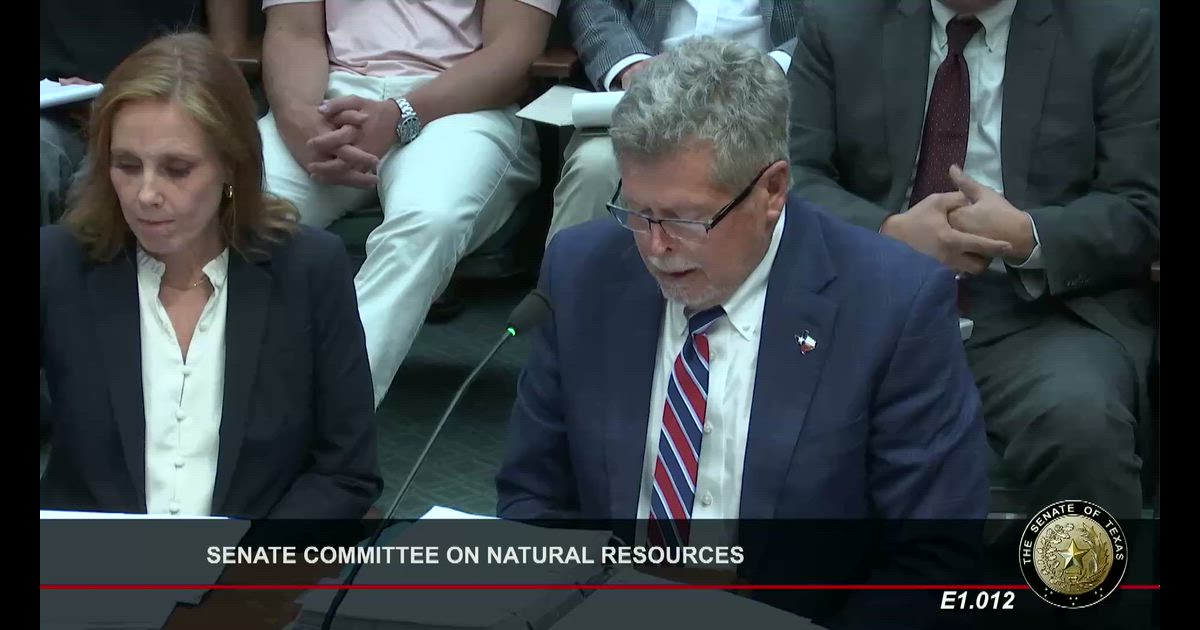 ▶ Watch this moment on USLege Wright asked the Legislature to draw the jurisdictional line between his agency and TCEQ in statute, arguing that regulators keep classifying the water by where it came from rather than by what it has become. TCEQ Executive Director Kelly Keel did not dispute the timeline, but she told Vice Chair Sen. Judith Zaffirini that the agency has the statutory authority it needs and will implement whatever the Legislature passes. She described six pending discharge applications, seven pending applications under the land-application program SB 1145 created, which is state-only, and two rulemakings, the first of which drew about 450 comments. She described the review as an administrative screen followed by a technical review against the state’s surface water quality standards, including low-flow and drought conditions and dissolved oxygen modeling, carried out by staff hydrologists and biologists. Industry sided with Wright and added a specific ask: state in statute that once treated, the water is no longer produced water. A representative of the Permian Basin Petroleum Association said the request is not for faster timelines but for timelines at all. Julie Range, policy manager at Commission Shift, an oil and gas accountability group that had been cautiously optimistic about moving the program to TCEQ, testified against the proposed rules, saying they fail to set protective surface water quality standards for numerous hazardous compounds and set no concrete limits to guarantee treatment meets them. No member questioned her. Sen. Tan Parker proposed convening a working group of agencies and industry this fall, and Sparks endorsed it on the record. Why it matters Two agencies gave the committee opposite answers to the same question. One says the boundary between them has to be fixed in statute; the other says it already has what it needs. That disagreement, not the permit count, is what a 2027 bill would have to resolve, and the working group proposed for this fall is where the language gets written. |
| | 04 · Agency review The Sunset Advisory Commission Opened Its Texas Workforce Commission Review and Set a September 29, 2026 Deadline for Changes Sunset Advisory Commission staff recommended moving regulation of career schools and colleges away from the Texas Workforce Commission (TWC) and restructuring its vocational rehabilitation program, two of nine numbered issues presented at a hearing on August 12, 2026 covering TWC, the Texas Workforce Investment Council, and the Purchasing from People with Disabilities Program. Under the Sunset process, staff investigate an agency and publish a report organized into numbered issues, the commission takes public testimony, and members vote issue by issue at a later meeting; what survives becomes a bill, and if lawmakers do nothing the agency’s authority expires. The commission set the rest of that calendar at this hearing: written public comment closes August 17, 2026, members can file changes and new recommendations through September 29, 2026, and the votes come November 18 and 19, 2026. The career schools recommendation would hand that program to the Texas Department of Licensing and Regulation. The vocational rehabilitation recommendation would abolish the program’s regional structure, which staff estimate would let TWC redistribute about 200 staff and $10.6 million a year within the program. Chair Sen. Lois Kolkhorst spent much of the hearing on technology instead. On the unemployment insurance system replacement, $40 million was appropriated to modernize tax, benefits and appeals; the scope was cut to the tax function alone; the full amount has been obligated and about $25.8 million spent as of August 2026; and the launch moved from 2023 to December 2026.
“So if I’m a taxpayer listening out here, I’m not impressed at this point.”
Sen. Lois Kolkhorst, Texas Senate District 18, Chair of the Sunset Advisory Commission, August 12. 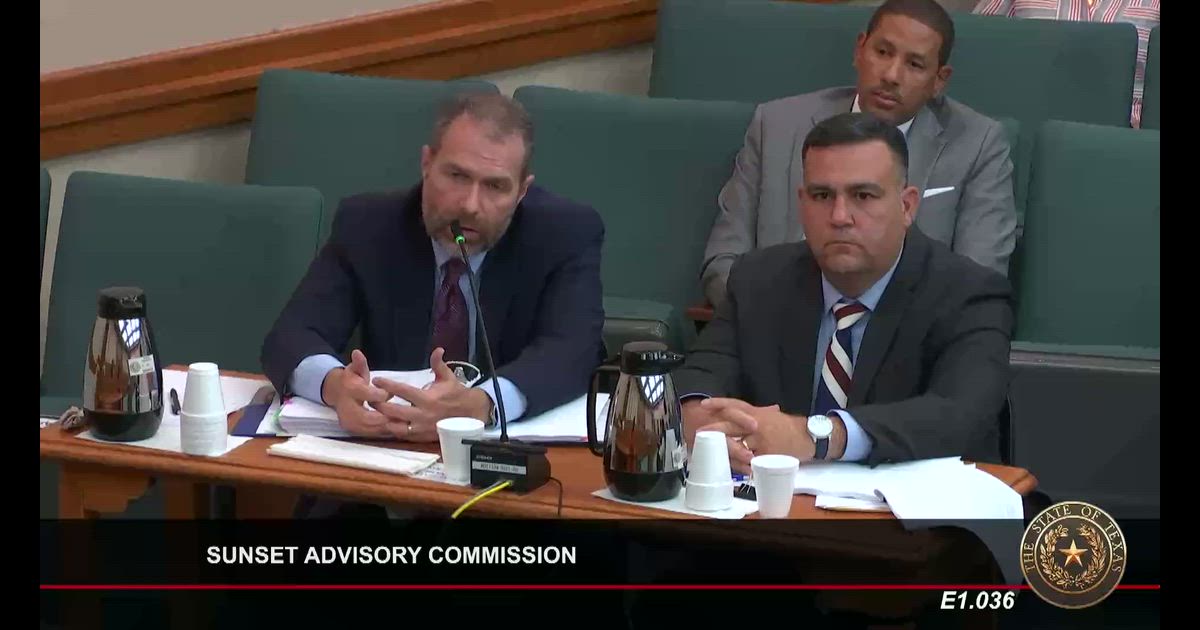 ▶ Watch this moment on USLege TWC Executive Director Steve Pier opened by telling the commission the agency agrees with all of the staff recommendations. Later in the hearing he named one exception: he does not accept that TWC can increase its child care fraud work with existing resources, and said it needs a few more people doing it. Sunset staff had told Sen. César Blanco the opposite earlier in the same hearing. Blanco, who pressed staff on how the 28 local boards run those investigations without adding compliance burden on providers that follow the rules, also drew out a finding that cuts the other way: Texas’s child care improper payment rate runs well below the national average, and staff said they have no evidence the state is losing tens of millions of dollars to child care fraud. The Texas Workforce Investment Council, for its part, formally opposes the recommendation that would move its oversight of the local workforce boards to TWC, and Kolkhorst pressed its staff director on how the council would obtain the visibility it says it lacks if the recommendation is rejected. Twenty-two witnesses registered to testify. Several child care and employer groups asked the commission to adopt the coordination recommendation and go further, extending it beyond TWC and the Department of Family and Protective Services to the Health and Human Services Commission and the Texas Education Agency, citing conflicting requirements from different agencies that raise costs for small providers. Why it matters Nothing here is settled yet, which is the point. September 29, 2026 is the last date anyone can move language into the bill before the commission decides in November what it sends the Legislature, and written comment closed on August 17, 2026, the day before this issue. |
| | 05 · Environmental enforcement TCEQ Postponed a Tarrant County District’s Petition Over Notice, Then Approved $2.07 Million in Penalties Tarrant County Fresh Water Supply District No. 2 asked the Texas Commission on Environmental Quality (TCEQ) for additional wastewater and drainage powers at its agenda meeting on August 12, 2026. Nobody appeared for the district, and the applicant itself had not filed with the chief clerk the newspaper tear sheets or publication affidavits that prove notice was published, though the executive director’s supplemental filing did include tear sheets, which the chairwoman said arguably showed substantial compliance. Both the executive director’s staff and the Office of Public Interest Counsel, the office inside TCEQ that represents the public as its own party, recommended granting the request, and Commissioner Catarina Gonzales said she was comfortable doing so. Then Commissioner Tonya Miller objected.
“I think our rules require that the applicant submit evidence of the published notice by filing copies with our chief clerk and we allow for them to even show up at this hearing and do that. And they have chosen not to do so either before or at this hearing. So I would suggest that we postpone this matter to our future agenda.”
Commissioner Tonya Miller, Texas Commission on Environmental Quality, August 12. 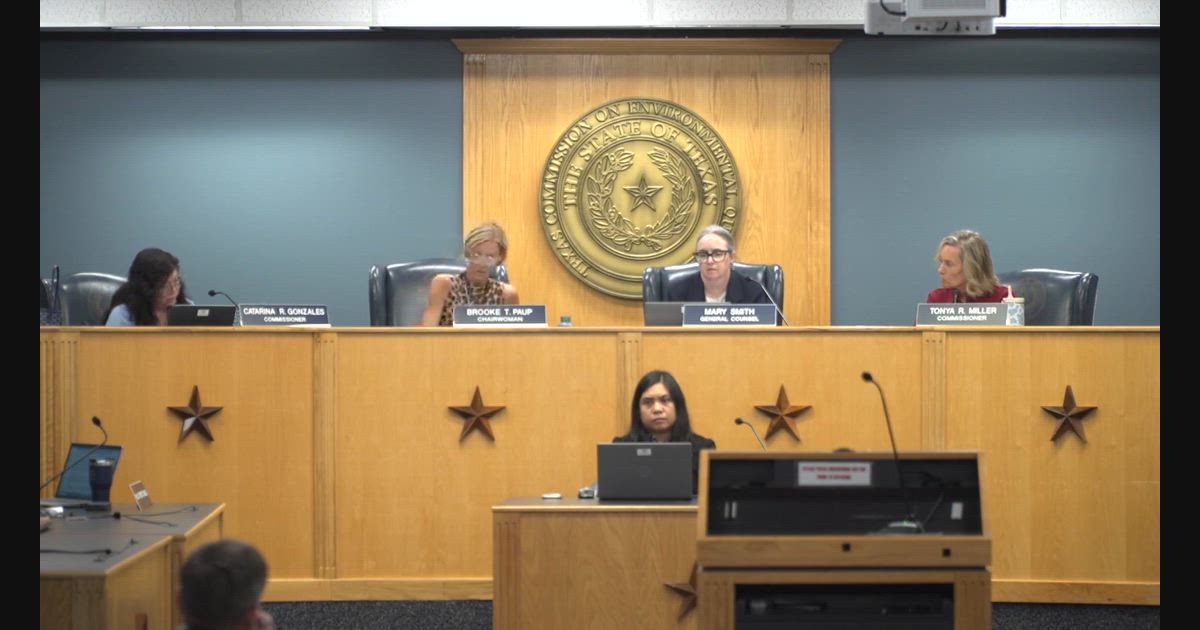 ▶ Watch this moment on USLege Chairwoman Brooke Paup joined Miller, and the commission voted without objection to continue the matter to a future agenda. Later in the meeting the commission took up a 40-item enforcement docket. Staff told the commissioners it carried $2,074,420 in assessed administrative penalties, of which $251,272 was deferred, $502,693 was directed to supplemental environmental projects, which are local environmental improvements a violator funds instead of paying that portion to the state, and $1,320,455 went to general revenue. All 40 items were approved in a single motion. The commission also sent two rulemakings out for publication in the Texas Register. The first implements SB 1302 from the 2025 session, which amends the Water Code so that a discharger denied or suspended from a general permit for an unsatisfactory compliance history on or after September 1, 2025 cannot discharge under that general permit again until the executive director actively authorizes it, and bars any automatic process from doing so; a hearing is set for September 28, 2026. The second adopts four federal hazardous waste checklists and revises how existing permit holders demonstrate financial capability; that hearing is September 22, 2026. Why it matters The compliance-history rule changes renewal exposure for anyone operating under a general permit, and both rulemakings carry September 2026 hearing dates once they publish in the Texas Register. The postponement is the practical lesson underneath: on a petition that staff and public counsel had both recommended granting, the commission required the applicant’s own proof of published notice before acting. |
| | 06 · Water money The Water Development Board Asked for 64 Positions to Prepare for Proposition 4 Money Arriving in September 2027 The Texas Water Development Board approved its 2028 and 2029 legislative appropriations request on August 14, 2026. It carries eleven exceptional item requests, all general revenue, totaling just over $74.2 million and 64 positions. The largest staffing item, $12.6 million and 50 positions, funds jobs the agency identified during the 2025 session to deliver financial assistance to communities and to prepare for money coming from Proposition 4, the constitutional amendment Texas voters approved on November 4, 2025. That amendment dedicates the first $1 billion a year of state sales tax revenue above $46.5 billion to the Texas Water Fund, beginning September 1, 2027 and running through August 2047. Chairwoman L’Oreal Stepney asked how the Proposition 4 dollars themselves get appropriated. Chief Financial Officer Georgia Sanchez answered that they are not in the bill pattern, the agency’s own section of the state budget, that the board was voting on.
“The Texas Water Fund in the current biennium is not an appropriated fund, and we are working with the LBB [Legislative Budget Board] to ensure that the prop four money that is expected to come in in fiscal year twenty eight and in fiscal year twenty nine is appropriated and is included as part of the bill pattern. But you’re correct. It is not contained in this bill pattern in anywhere other than schedule six h.”
Georgia Sanchez, Chief Financial Officer, Texas Water Development Board, August 14. 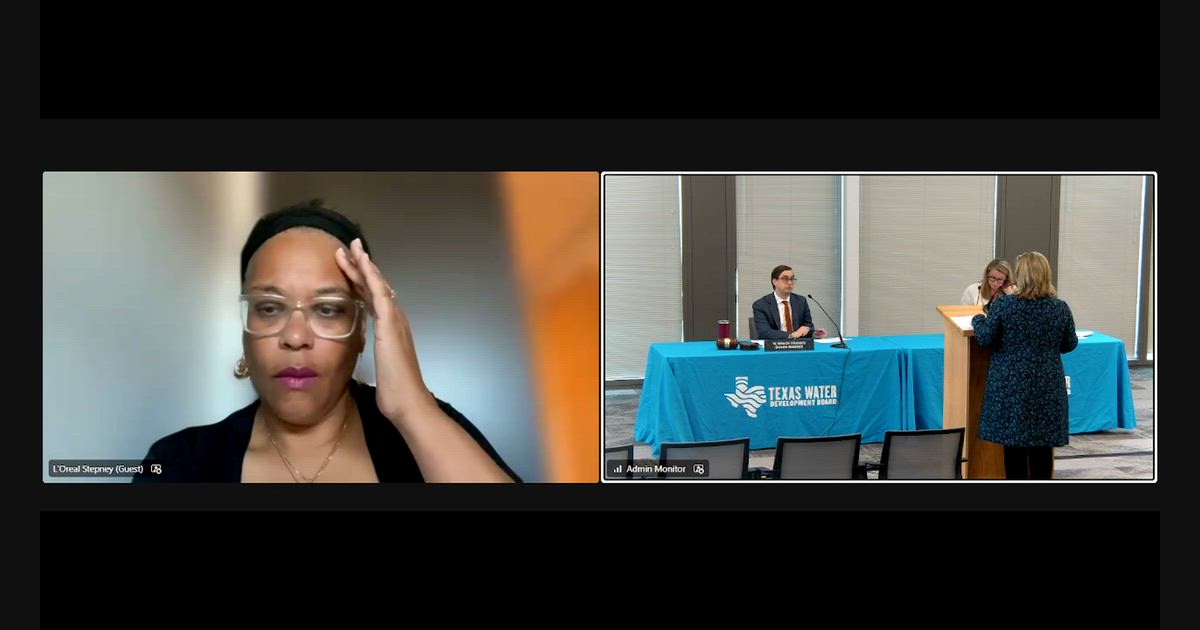 ▶ Watch this moment on USLege The request looks far smaller than the last one, and a board member said why: most of the drop is one-time money coming off the books rather than a program cut, though the request also carries a directed 3 percent general revenue base reduction of just under $4.1 million. That one-time money includes $1.025 billion in supplemental water supply and infrastructure grants and just over $582 million in one-time grants the Legislature directed in 2025. The same board member said several of the exceptional items look to him more like routine operations than extraordinary needs, and that he hopes they are built into the base budget by the time session starts. He voted for the request. Demand is running well ahead of the money. A board member reported 682 applications to the water supply infrastructure grant program, and said the State Water Implementation Fund for Texas, or SWIFT, drew more applications than it could fund for the first time this year. Why it matters The people and the construction money are moving on two different tracks. The 50 positions are in the request the board just approved; the Proposition 4 transfers are not, and the agency says it is working with the Legislative Budget Board to get them into the appropriations bill for 2028 and 2029. Anyone waiting on a water project has two approvals to watch, not one. |
| | Texas in Washington A Witness Put Federal Counter-Drone Certifications at 61 Officers Nationwide, Nine of Them in Texas The Texas Senate Select Committee on Homeland and Border Security spent August 12, 2026 on drones. Testimony described the SAFER SKIES Act, enacted in December 2025 as part of the fiscal year 2026 National Defense Authorization Act, as the first federal law giving state, local, tribal and correctional agencies authority to take down a drone. A witness told the committee that the Federal Bureau of Investigation’s National Counter-Unmanned Aircraft Systems Training Center, the sole federal certifying authority for those operators, had certified 61 officers nationwide as of late July 2026. A Department of Public Safety captain corrected the Texas number on the record: nine Texans are certified, two of them at the department. Texas has more than 2,700 law enforcement agencies. The same captain testified that roughly 90 percent of the department’s drone fleet is built by companies headquartered in adversary nations, and that the department now buys only systems compliant with the National Defense Authorization Act and is replacing the rest as aircraft age out. Witnesses also said the interim final rule implementing the new authority is narrower than the statute, that an airport authority owns takedown equipment it is not permitted to use, and that the rulemaking is still open for comment. Chair Sen. Phil King asked the department for a plan, in short order, for how it could run a statewide drone detection and mitigation task force. Sen. Bob Hall gave witnesses 30 days to return a list of what they need, including statutory authority. |
| Also moving this week
The Gulf Coast Protection District was told on August 12, 2026 that the General Land Office will again request $100 million in state money for Coastal Texas, the federal and state coastal storm risk program, and that the United States Army Corps of Engineers has agreed to contribute $325,000 toward the office’s Coastal Texas work, matched by $175,000 of the office’s own funds. The office’s representative described that $325,000 as its first increment of federal funding for the program. Set against the $100 million state request, it is roughly a three-hundredth of the ask.
The Towing and Storage Advisory Board at the Texas Department of Licensing and Regulation was briefed on August 12, 2026 on a study that will recommend statewide fees for towing from private property, examining current fee structures, regional variation, and what it costs to provide the service. No fee change was adopted; the study is the step.
The Texas Department of Motor Vehicles board approved its fiscal year 2027 operating budget on August 13, 2026 and voted to publish a notice of intention to review Title 43, Chapter 221 of the Texas Administrative Code, the rules governing salvage and non-repairable vehicle titles and licensing.
|
| What we are watching Senate Natural Resources, September 21, 2026. The committee takes up its remaining interim charges at 9 a.m. Its wildfire charge, heard August 11, produced the week’s lowest capacity figure: Texas Division of Emergency Management Chief Nim Kidd told the committee that 14 aircraft are assigned to firefighting duty in Texas, 11 of them under United States Forest Service contract and 3 state-owned, and that current appropriations do not let the Texas A&M Forest Service contract for exclusive-use aircraft beyond what the state already owns. Vice Chair Sen. Judith Zaffirini asked the first panel to answer two elements of the charge in writing: the effectiveness of fuel management practices, and the vulnerability of utility infrastructure alongside the adequacy of early warning systems. 765 kilovolt lines, August 19, 2026. The House Committee on State Affairs meets at 8 a.m. in the John H. Reagan Building to review the regulatory and planning processes for the proposed 765 kilovolt transmission lines. In-person testimony is limited to two minutes and speaker registration closes at 10 a.m. that morning; the committee is taking electronic comments until it adjourns. Chairman Gleeson separately said the commission’s next open meeting would take up 765 kilovolt policy. Sunset dates. Written public comment on the Texas Workforce Commission review closed August 17, 2026. Commission members can submit changes and new recommendations through September 29, 2026. Decisions come November 18 and 19, 2026. Two TCEQ rule hearings. September 22, 2026 on the hazardous waste package, and September 28, 2026 on the compliance-history general permit rule implementing SB 1302. A produced water working group. Sen. Tan Parker asked for a full day this fall with agencies and industry in one room, and the chair endorsed it. No date has been set. | What we are tracking Texas is starting to ask who is accountable when a state system does not work Two of this week’s hearings turned on technology projects that have not delivered what was appropriated for them. The Sunset review of the Texas Workforce Commission covered an unemployment insurance system that has obligated its full $40 million appropriation and spent about $25.8 million of it, shed its benefits and appeals scope, and still has not launched, and a child care payment system that the Sunset report says launched with payment delays, data errors and continuing functionality problems, which the agency’s executive director discussed from the witness table along with the remediation plan he said he required of the vendor’s leadership at no additional cost. Rep. Matt Shaheen told the commission the staff’s proposed remedy, a customer survey system, is too modest, and said the state should bring information technology vendors in to testify in public about what it is buying. The chair invited them from the dais. No vendor testified at either hearing. Systems of this kind, in eligibility, fraud detection and call handling, are among the first places state government is being asked to put artificial intelligence to work, and Texas is heading into the 2027 session with a live argument about who answers when one of them does not deliver. |
| Join us live Fall 2026 series · Session two Everyone is asking for an artificial intelligence strategy. Here is where lobbying practices start. Wednesday, August 26, 2026 · 1:00 p.m. Eastern · 45 minutes Covering every chamber for every client means tracking hearings, amendments and votes across dozens of moving targets at once. This session lays out a practical artificial intelligence strategy for a lobbying practice, a real-time way to catch every hearing, amendment and vote across every client, and a way to cover more clients with less manual tracking. Live questions and answers at the end. Register even if you cannot attend and we will send you the recording. Session three, on policy nonprofits, comes September 2, 2026. |
| Get your state’s weekly read Texas, DC, New York, California, and more editions rolling out every week. |
| | |
|