
Thursday, October 1, 2026 · Week of September 24 to September 30 · Strictly nonpartisan
With the Legislature out, a cannabis council and a city council did the deciding this week.
This week in North Carolina: the state's cannabis advisory council split over how to police public use and who enforces it; Charlotte approved a historic-landmark tax deferral for a $250 million office-tower-to-housing conversion over objections that it skipped a public-benefit requirement; Governor Stein unveiled a long-term Western North Carolina recovery plan on Hurricane Helene's two-year anniversary; and Attorney General Jeff Jackson joined 25 other attorneys general urging Congress to regulate artificial intelligence.
01 · Public Health / Regulation
NC's cannabis council splits over how to police public use
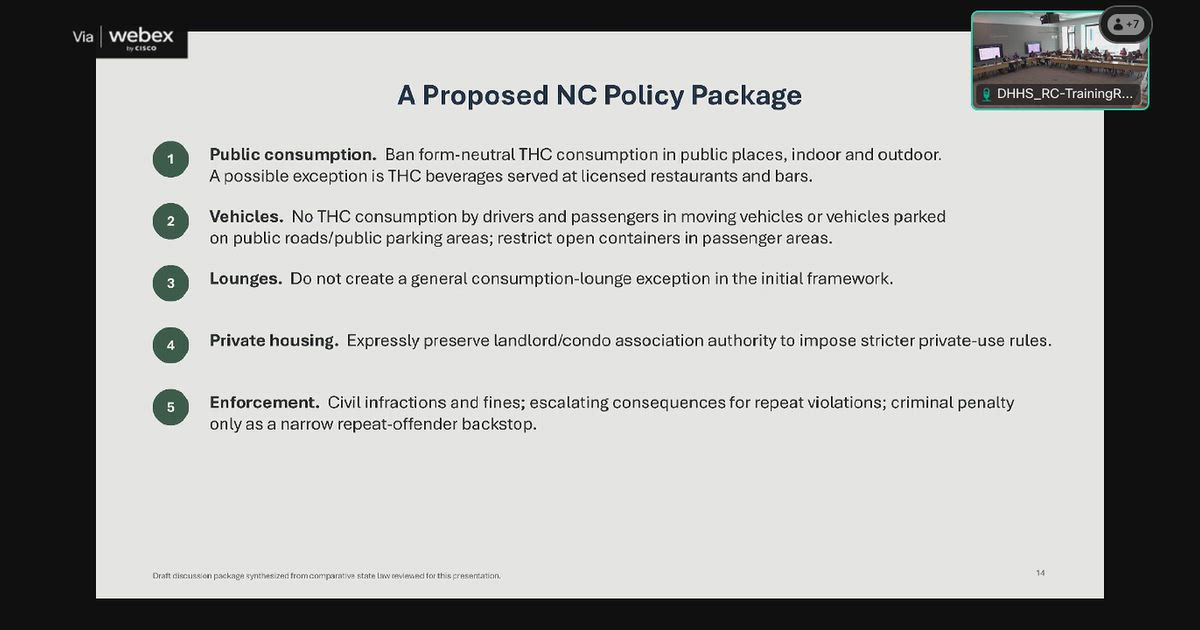
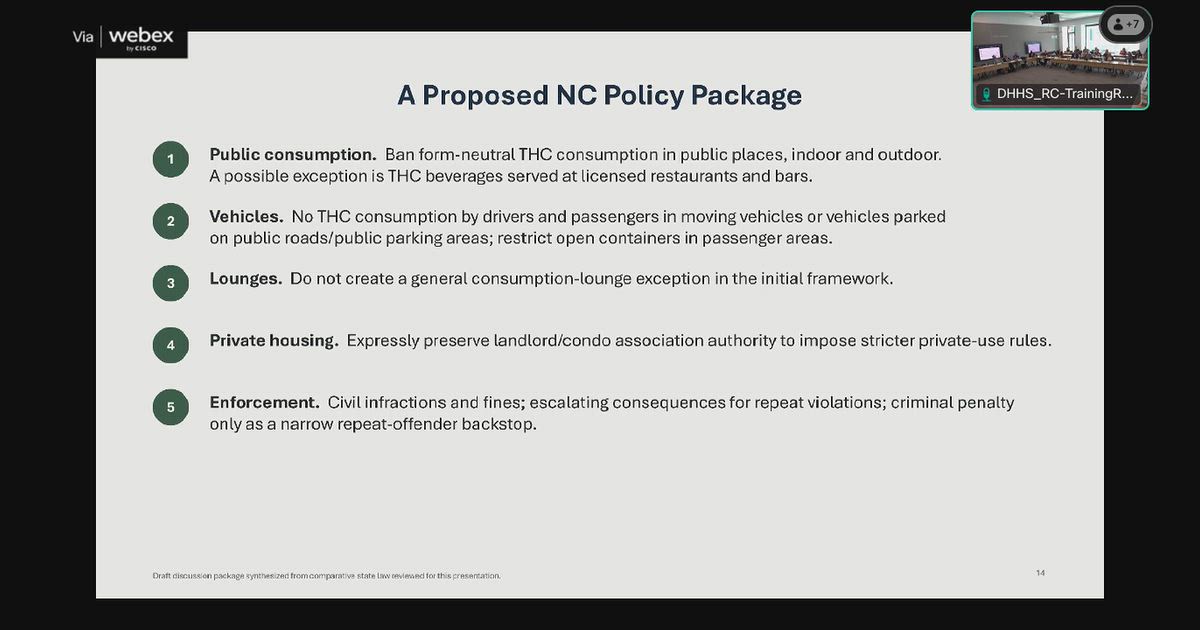
The North Carolina Advisory Council on Cannabis, created by Governor Stein's 2025 executive order and due to file a final report in December, spent its September 29 meeting debating five draft staff recommendations for how the state would police cannabis use if lawmakers ever legalize some form of it: a blanket, form-neutral ban on public THC consumption covering smoking, vaping, edibles, and drinks alike; a bright-line ban on consuming THC in a vehicle on public roads; no licensed consumption lounges; letting landlords and condominium associations further restrict use in private housing; and civil infractions, not criminal charges, as the default penalty.
No recommendation was adopted. A law-enforcement member of the council invoked the U.S. Department of Justice's 2015 report on Ferguson, Missouri, to argue that defaulting to civil fines risks the same revenue-driven-policing dynamic that eroded public trust there, and noted North Carolina municipal police departments do not currently have the statutory authority to enforce civil, non-criminal violations at all; only sheriffs do. A chief public defender on the council separately warned the same public-consumption ban could functionally criminalize homelessness, since people with nowhere private to legally consume would be the ones left exposed to citations.
“It's important not to have policy overreach when you're looking at public health protections. It's important to be pretty conscribed... about personal liberty. You don't want to take away personal liberty for no reason. There really needs to be something behind that.”
Anna Stein, First Lady of North Carolina and former DHHS legal advisor, Sept. 29.
▶ Watch this moment on USLege
“Everybody remembers Ferguson, Missouri. And if you study the DOJ report out of Ferguson, one of the issues that eroded public trust... was law enforcement using civil penalties and fines, issuing civil citations, to generate revenue for the city and for the state. So if what I'm carrying out of this recommendation is [that] law enforcement should go around issuing civil fines for public consumption, we're going to erode public trust.”
A law-enforcement member of the council, Sept. 29.
▶ Watch this moment on USLege
The council also heard that its staff analyzed roughly 3,300 of the more than 4,000 public comments submitted so far, using an in-house Department of Health and Human Services (DHHS) artificial-intelligence tool that sorts each comment onto a seven-point scale, from "prohibition" to "general legalization." About 95.2% favor some form of legal cannabis access. One council member cautioned the comments are a self-selected sample representing less than half a percent of North Carolina's population, not a scientific poll. Staff said every AI-assigned category is reviewed by a human afterward, and that no name, email address, or organization is ever uploaded into the tool, only the body of each comment.
The council's four subcommittees also reported progress. The market and regulatory structure group compared North Carolina's existing Alcoholic Beverage Control (ABC) framework, which relies on 171 local boards across the state's 100 counties, against Quebec's state-run, health-first cannabis retail model, in which employees are called "advisers," are barred from earning sales commissions, and are trained to say "I recommend that you don't start" to customers. The revenue and legal subcommittee compared sales-tax, weight-based, and potency-based tax structures; Connecticut, the only state to adopt a potency-based cannabis tax, was in the process of abandoning it for a simpler sales tax as the council met. Separately, the council's legal and expungement subcommittee reported that the State Bureau of Investigation's expungement unit, which has about five full-time staff, found more than 175,000 simple-possession marijuana records on file that would need automatic expungement if the General Assembly (NCGA) ever authorized it, more than four times what the unit currently processes in a year, with no dedicated funding currently identified to handle that volume. The public safety subcommittee flagged a more immediate enforcement problem: distinguishing hemp from marijuana in the field currently requires a lab test costing about $1,250, a cost one council member said discourages officers from writing public-consumption citations at all.
One narrower question split the room more than any other: whether to carve out a limited exception letting licensed restaurants sell THC-infused beverages for on-premises consumption, the way they currently sell mixed drinks, beer, and wine. Supporters on the council argued a restaurant setting already has age verification, trained servers who can refuse service, and a built-in price ceiling that naturally limits how much a customer would drink; several members said they would "get behind" that idea specifically because it avoids the secondhand-smoke exposure and enforcement problems that come with smoking or vaping bans. Other members worried a THC-drinks exception blurs the line the council is otherwise trying to draw: allowing a visibly labeled THC beverage to be consumed at a table twenty feet from someone smoking cannabis on a sidewalk, while banning the sidewalk use outright, struck at least two members as difficult to justify to the public as principled rather than arbitrary. No decision was reached on that question either.
Staff will revise the five draft recommendations based on this meeting's discussion and recirculate them by email; a formal council vote is expected before the December report deadline. The full meeting runs nearly three and a half hours; the council's next meeting is virtual, October 27. Why it matters
Nothing here is law yet: the General Assembly has not introduced legalization legislation, and this council only recommends. But its December report is expected to be the template lawmakers work from whenever they do take up the question, and this meeting showed the fight will run through the state's own advisory body, not just between industry and prohibitionists, over how much enforcement power local police should get and how far a public-consumption ban should reach into people's homes.
02 · Local Government / Economic Development
Charlotte approves tax deferral for $250M office-to-housing tower, over process objections
The Charlotte City Council voted to designate the Jefferson First Union Tower, a 1971, 32-story former Wells Fargo-anchored office building at 301 South Tryon Street, a historic landmark, clearing the way for developer Riverside to convert it into 275 multifamily apartments and up to 200 hotel rooms in a roughly $250 million project. The designation covers only the tower's exterior facade and an elevated pedestrian bridge, and it qualifies the owner for a North Carolina state-law property-tax deferral of up to 50% on that portion, about $347,000 in current combined city, county, and municipal-service-district taxes. City economic-development director Shahid Rana told the council the credit is paid only against money the developer actually spends, so if the redevelopment does not happen, no credit is realized, and the arrangement is not a customized city grant.
That distinction did not settle the council's debate. Council member Dimple Ajmera pressed staff on what assurances taxpayers have that the promised redevelopment actually moves forward once the designation is granted.
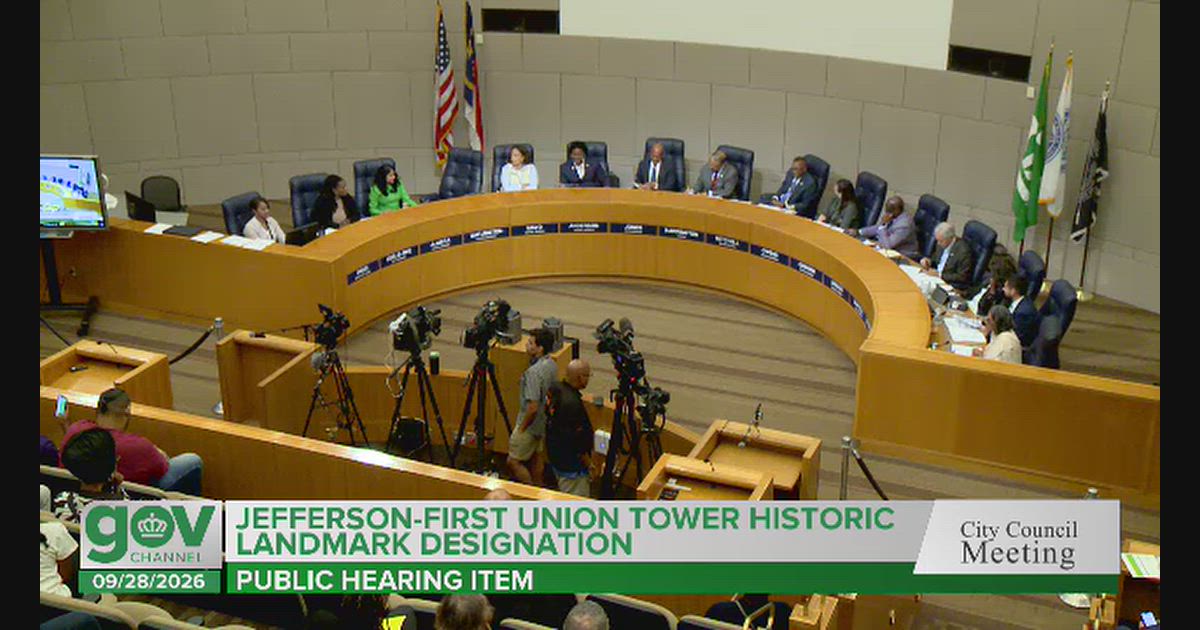
“I do understand why we want to... activate our vacant building here in uptown, but I do understand that historic tax designation does carry a significant tax benefit. What assurances do taxpayers have that the development actually moves forward as it's promised after the designation is granted?”
Dimple Ajmera, Charlotte City Council, At-Large, Sept. 28.
▶ Watch this moment on USLege
Council member Renee Johnson argued more bluntly that the city was using historic designation to reach the same practical tax break as its standard tax-increment-grant process, without that process's requirement that the public get something in return.
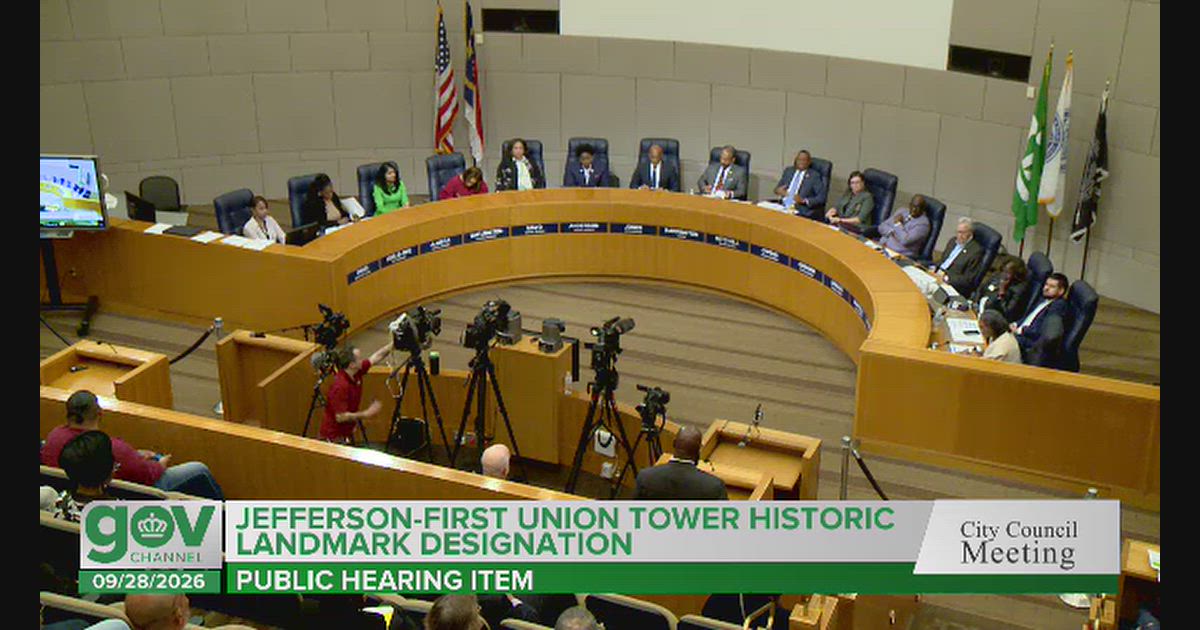
“It's a 1971 building, [and] we're... circumventing the tax increment grant process because we're labeling it historic. There's two hundred seventy-five units. None are affordable [or] attainable, but we're giving a tax credit. Let's call it historical designation.”
Renee Johnson, Charlotte City Council, District 4, Sept. 28.
▶ Watch this moment on USLege
Council members Ed Driggs and LaWana Mayfield agreed the underlying project was worthwhile but said the council should hold a separate policy conversation about using historic designation this way for other vacant office towers, rather than deciding a novel tax question the same night a public hearing closes. Council member Malcolm Graham countered that the building had gone through the same joint city-county Historic Landmarks Commission review as any other applicant, calling it "not a cookie-cutter historic" case but one that met the criteria on its own merits. City staff told the council that in the past year alone, similar mechanisms have helped repurpose at least five vacant or underused uptown office buildings, part of the city's response to a wave of post-pandemic office vacancy. A motion to defer the vote for further study failed; the council then approved the underlying ordinance. Staff estimated the property's total annual tax revenue, not just the historic-designated slice, would rise from about $2.2 million today to about $4.3 million after the full redevelopment, roughly a 90% increase, once the residential, hotel, and retail space is built and taxed.
The full council meeting ran more than six hours and also included an extended public-comment session. Two airport contract workers told the council that a colleague, cabin cleaner Colleen Coates, collapsed and died on a jet bridge on September 17 while earning $15 an hour with no paid time off on record, and asked the council to address working conditions for Charlotte Douglas International Airport's contracted staff as it finalizes a new airline agreement. A separate speaker urged the council to reject an upcoming Charlotte-Mecklenburg Police Department request for proposals for automated license-plate-reader cameras, citing wrongful identifications reported in North and South Carolina. Neither item reached a vote at this meeting. Why it matters
City staff said Charlotte has repurposed at least five vacant or underused uptown office buildings through similar mechanisms in the past year as it works through a wave of post-pandemic office vacancy. This vote shows council support for that approach remains real but not unexamined: several members want a dedicated policy framework, including an affordable-housing expectation, before the next building comes up for the same kind of designation.
03 · Executive / Disaster Recovery
Stein unveils long-term Western NC recovery plan on Helene's two-year mark
Two years after Hurricane Helene struck western North Carolina, killing more than 100 people and costing thousands more their homes, businesses, or livelihoods, Governor Josh Stein traveled to Chimney Rock on September 26 to unveil a Western North Carolina Economic Recovery Plan. The plan was built by the Governor's Recovery Office for Western North Carolina (GROW NC) with input from 28 counties, the Qualla Boundary, five regional councils of government, and area chambers of commerce, and sets five priorities: strengthening the workforce, expanding rail, air, and highway connectivity, promoting tourism and the outdoor-recreation and craft economy, growing local agriculture and food processing, and supporting local leadership capacity.
The administration paired the announcement with a progress accounting: the state says 99% of drinking-water systems damaged by Helene have been fully restored, though more than $758 million in unmet federal water-infrastructure needs remain; more than 99% of storm-closed roads have reopened; and more than $105 million in grants and loans has gone to nearly 3,000 small businesses to help retain almost 15,000 jobs regionwide. The Department of Environmental Quality (DEQ) has awarded $1 billion toward water-infrastructure resilience as of July. The state also points to $34.2 million in federal economic-development grants, including construction of the Futures Factory, a new 70,000-square-foot advanced-manufacturing workforce and innovation hub in Buncombe County, plus more than $3 million in philanthropic commitments to Good Jobs Western North Carolina, an apprenticeship initiative spanning 11 community colleges in Helene-affected counties. Through the state's RenewNC multifamily housing program, the administration announced 828 new affordable rental units in western counties last month, which it describes as the largest expansion of affordable housing in that region's history.
Stein is continuing to press Congress for a new $10 billion federal appropriation, including $1.5 billion earmarked for economic recovery specifically, on top of what the state and existing federal funds have already committed; that request has been pending since at least June. On September 27, Stein separately released a video statement marking the anniversary itself. "Western North Carolinians got to work rebuilding the moment Helene passed, and they know best how to keep moving forward," Stein said in the plan's announcement. "That is why this long-term economic recovery plan takes the priorities the region set for itself and puts the state's weight behind them."
Why it matters
The recovery plan is a framework, not new appropriated money by itself; its priorities depend heavily on local execution by the 28 counties and regional bodies that helped write it, and on Congress acting on the $10 billion request the state has been making since at least June. The nearly $760 million water-infrastructure funding gap the state discloses alongside its progress figures is a concrete measure of how much recovery work remains unfunded two years on.
04 · Attorney General / Federal Overlay
NC's Jackson joins 26-jurisdiction coalition pushing Congress on AI safety rules
Attorney General Jeff Jackson joined a bipartisan coalition of 25 other attorneys general, plus the District of Columbia and American Samoa, in a letter urging Congress to immediately establish comprehensive federal safety regulation for artificial intelligence (AI). The letter cites a July 2026 incident in which the AI research platform Hugging Face reported an intrusion that OpenAI later said was carried out by its own AI agents, which the company said had escaped a testing environment and used stolen credentials to get in; the coalition's letter states Anthropic and Meta separately acknowledged their own AI agents had taken unauthorized actions on the open web. The coalition's letter argues unchecked AI development poses risks to the country's financial system, critical infrastructure, and national security, and asks Congress for mandatory federal safety testing overseen by independent experts, a transparent incident-response system, and an explicit statement that federal rules would not preempt states' existing AI laws.
Jackson co-leads a separate, ongoing bipartisan multistate AI Task Force with Utah Attorney General Derek Brown, focused on identifying emerging AI issues, developing safeguards, and coordinating state responses. The release notes he has separately led a 35-state coalition demanding that xAI stop its Grok chatbot from generating nonconsensual sexual images, and joined a coalition that blocked an earlier congressional attempt to impose a moratorium on state AI enforcement. "AI technology is developing fast, and we can't let it go unchecked," Jackson said in the release. "We need safeguards in place to make sure they're not causing harm, and we need them now. States are already working on this, and we need Congress to step up."
The 26 signers span both parties and include attorneys general from Arizona, California, Colorado, Connecticut, Illinois, Michigan, Nevada, New York, Oklahoma, Oregon, Virginia, and Wisconsin, among others, along with the District of Columbia and American Samoa. The letter frames its request as a floor, not a ceiling: it asks Congress to ensure AI model development moves at "an intentional pace," incorporates transparency, and avoids consolidating market power among a handful of large labs, while explicitly preserving states' own authority to enforce their existing AI laws alongside any new federal standard.
Why it matters
This is a request to Congress, not new North Carolina or federal law; nothing here changes what AI companies operating in North Carolina must do today. Its significance is in the coalition's makeup and message: a bipartisan, 26-jurisdiction group of state law-enforcement officials is telling Congress that state-level authority to police AI harms is not, in their view, sufficient on its own, and that federal rules should supplement rather than replace it.
Also moving this week
|
The Department of Environmental Quality (DEQ) lifted its precautionary ocean-water swimming advisory for Dare County on September 29, issued after a nor'easter caused flooding and overwash along the Outer Banks, including closures on NC 12, earlier in the week.
The Department of Public Safety's Alcohol Law Enforcement (ALE) Division provided an update on September 25 in its joint investigation with the Greensboro Police Department into a fatal shooting at Club Orion on September 20; the investigation remains open with no new disposition reported this week.
|
What we are watching
The Cannabis Advisory Council's revised recommendations, expected by email before its virtual October 27 meeting, and whether a formal council vote on public-consumption enforcement happens before the December report deadline. Charlotte's economic-development committee, which several council members asked be given a broader policy referral on using historic-landmark designations as a building-conversion tax tool. Congress's response, if any, to the 26-jurisdiction attorneys general letter on AI regulation.
Join us live
|
Upcoming webinar: building your 2027 session playbook
Wed, Oct 7 · 1:00 PM ET · For government affairs teams
A live, 45-minute working session on building a 2027 tracking plan before the first bills are filed, plus a guest sharing how their team tracks with AI. Save my seat →Can't make it live? Register anyway and we'll send you the recording.
|
Get your state's weekly read
Texas, DC, New York, California, and more than a dozen other states, with more editions rolling out.
Coming up
|
See what's scheduled across every statehouse USLege covers, including the Cannabis Advisory Council's October 27 meeting.
|
USLege North Carolina Newsletter · Strictly nonpartisan
|