|
Friday, October 2, 2026 · Week of September 25 to October 1 · Strictly nonpartisan
Arizona's out-of-session government this week: bipartisan pushback on 30-year solar leases as housing demand grows, an Attorney General pressing the state's elected utility regulator and Congress, and Arizona's delegation split over how to secure the Colorado River.
A bipartisan legislative panel presses the State Land Department over a 30-year solar lease auctioned near a growing housing corridor even as the agency reports record trust-fund revenue; the Attorney General asks Arizona's elected utility regulator to reopen a rural water-rate case and joins a multistate call for Congress to regulate artificial intelligence; and Arizona's congressional delegation splits between a Republican-backed Colorado River water-supply bill and a Democratic push for Grand Canyon flood recovery funding.
01 · State Trust Land & Energy
State Land Commissioner Faces Bipartisan Pushback Over 30-Year Solar Leases as Housing Demand Grows Nearby
At the Sept. 29 hearing of the Joint Legislative Ad Hoc Committee on State Land Oversight, a bipartisan panel created this year to track the State Land Department's implementation of a package of reforms, Commissioner Robyn Sahid told the committee the agency is working through 25 separate requirements from this year's continuation legislation: posted lease and application terms, a new administrative-completeness review with written deficiency notices, criteria for commissioner-initiated sales, and a six-month notice requirement before lease-term changes. Most target dates fall between November 2026 and the end of 2027.
Sahid reported a record fiscal year: $670.7 million in cash revenue deposited into the permanent land endowment trust fund, whose earnings fund Arizona's K-12 schools and other beneficiaries, and a record number of public land auctions. She said the department has 12 residential auctions in its pipeline this fiscal year, covering about 7,600 acres, which she estimated could support roughly 27,000 housing units at an average density of 3.5 dwelling units per acre. The department also has 22 active solar leases, 30 years each, with a combined minimum estimated value of about $592 million to beneficiaries, and six wind right-of-way projects in various stages.
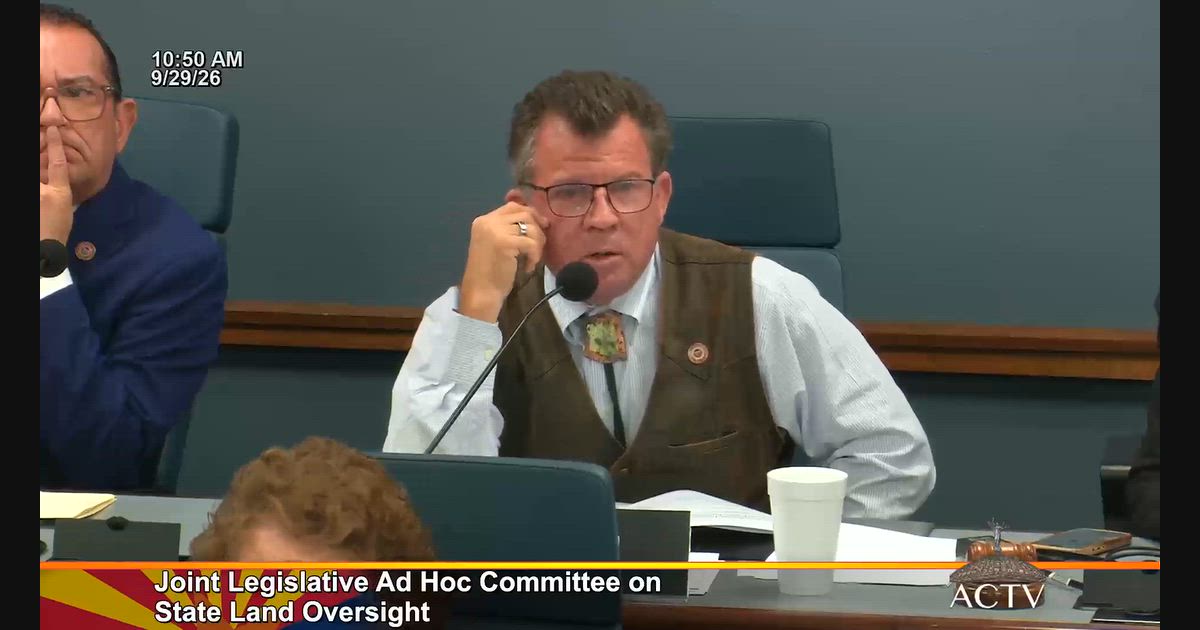
Sen. David Gowan (R) pressed Sahid repeatedly on one lease in particular: a 30-year, solar-only commercial lease near Sierra Vista, in a growth corridor he said sits near planned Fort Huachuca expansion, that drew a single bidder. Gowan argued the department should open such auctions to any commercial bidder, including homebuilders, rather than restrict them to solar from the outset, and said the land would otherwise be well positioned to help address the area's housing needs.
"Going back to my original ask is why? Why would we do this, thirty years, one vendor? Why would we do that?"
Sen. David Gowan (R), questioning Commissioner Robyn Sahid on the Sierra Vista-area solar lease, Sept. 29.
▶ Watch this moment on USLege
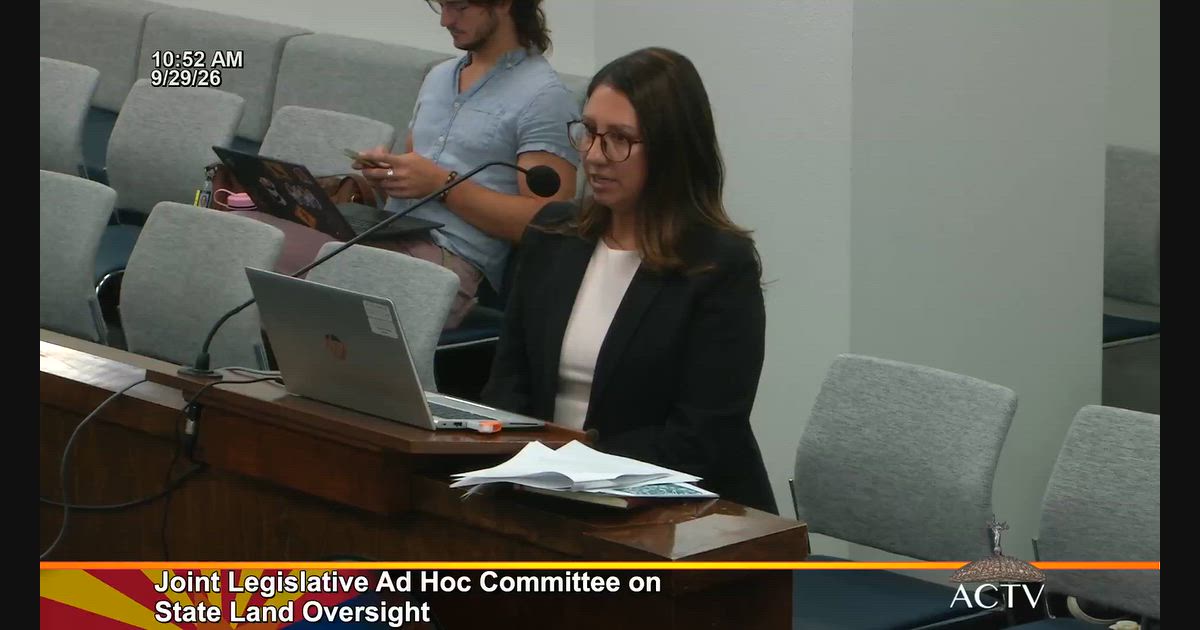
Sahid responded that solar leases generally go on land that lacks the roads, water, and wastewater service other commercial development would need, and that the department cannot dictate a winning auction bidder's eventual use of the land once it goes to public sale.
"If there were a higher and better use ready to go interest, all of that, we would certainly entertain it. ... And we would work with them to determine if that's realistic."
Robyn Sahid, Commissioner, Arizona State Land Department, on whether the department would revisit a parcel's use if a local jurisdiction wanted something other than solar, Sept. 29.
▶ Watch this moment on USLege
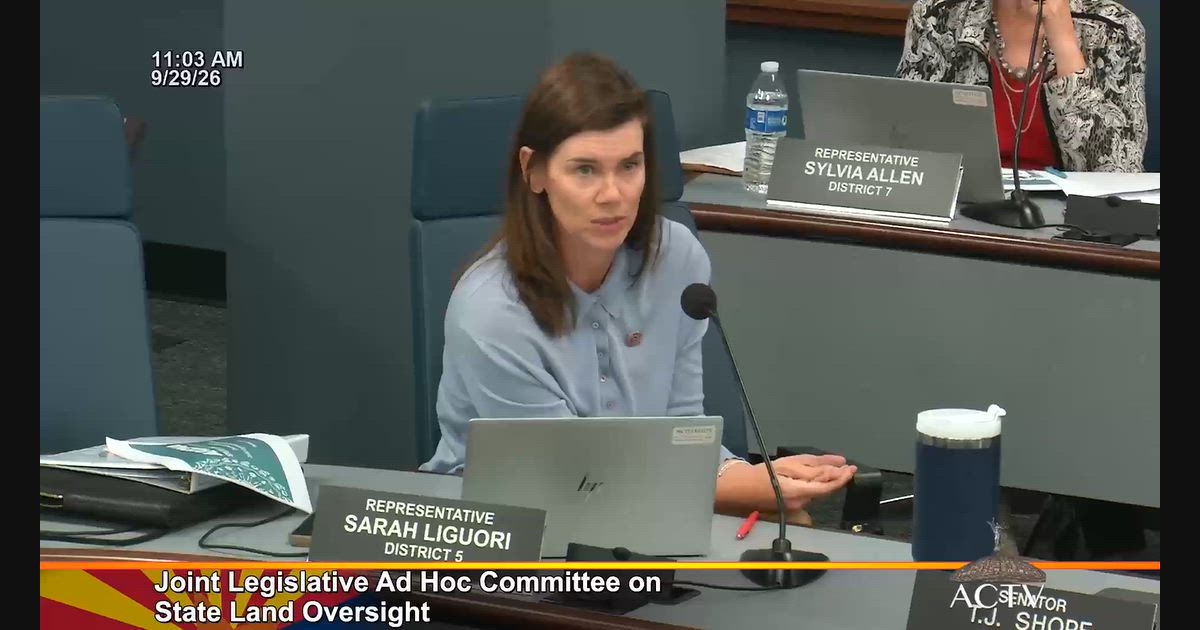
Rep. Sarah Liguori (D), a former financial advisor, argued against judging any single lease in isolation, framing the department's duty as a long-term fiduciary one to the trust's beneficiaries rather than a choice between industries.
"The state land department has a fiduciary responsibility as a trustee, and I don't want these conversations to get bogged down in the picking, winning, and losers side of the department, or even this governing body at the legislature."
Rep. Sarah Liguori (D), Sept. 29.
▶ Watch this moment on USLege
Sen. Mitzi Epstein (D), sitting in for Sen. Rosanna Gabaldón, and Rep. Sylvia Allen (R) both pressed Sahid separately on the department's multi-year application backlog, some of it more than three years old. Sahid said the department is sending letters to applicants in dormant cases asking whether they want to proceed or withdraw, building a tracking system so no letter goes unanswered, and using a new Salesforce dashboard to flag leases approaching expiration before they fall into holdover status. She said the backlog has fallen from roughly 2,000 applications when she took office to a more manageable pace, even as the department fields about 186 new applications a month.
"Arizona is booming. People want to be here. We're seeing a lot of applications, and we don't have the resources necessary to match."
Robyn Sahid, Commissioner, Arizona State Land Department, answering Rep. Sylvia Allen (R) on the biggest obstacle to clearing the application backlog faster, Sept. 29.
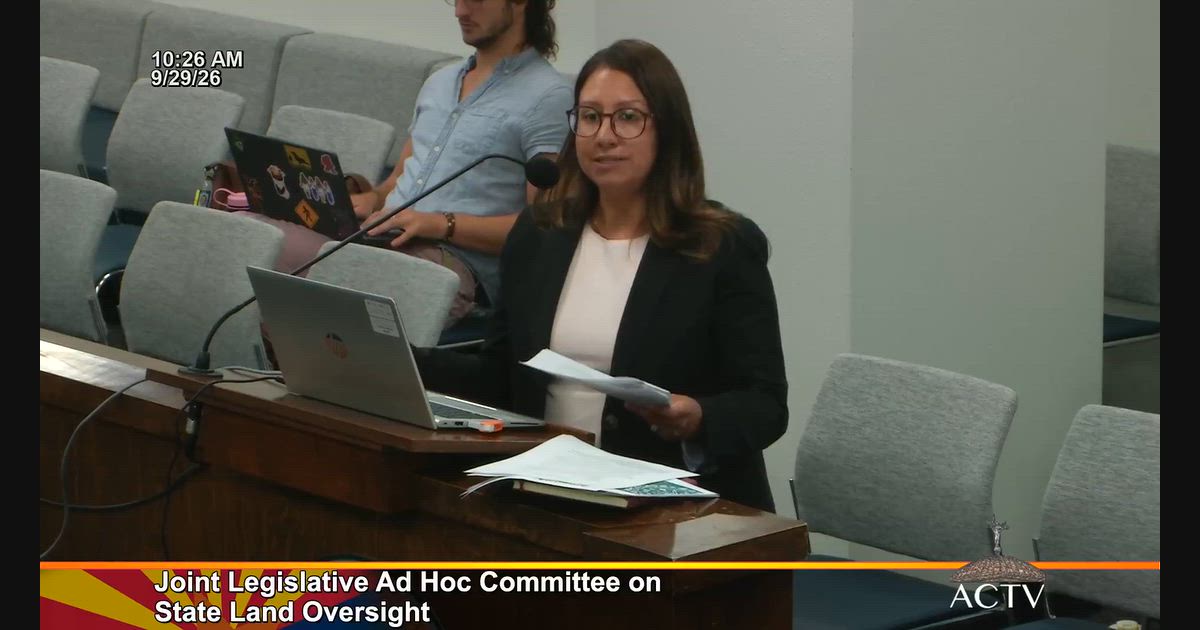
▶ Watch this moment on USLege
Members also asked about the department's newly posted criteria for "commissioner-initiated sales," in which the department itself acts as the applicant on a complex site rather than waiting for a private applicant to do the due-diligence work. Sahid cited a parcel at Bell Road and Loop 101 in North Scottsdale as an example: a prime but heavily constrained site with no private applicant willing to invest the time to prepare it, which the department itself readied for auction and which drew multiple bidders and, she said, a strong return for the trust. Committee members separately asked Sahid to provide, in writing, the department's response to all 51 outstanding recommendations from the Auditor General and sample copies of solar-lease bonding, insurance, and reclamation language, which she agreed to supply.
Why it matters: The committee took no vote and has no authority to reopen a completed auction. The exchange previews a recurring tension as more state trust land near growing areas comes up for lease or sale: whether Arizona's auction-driven trust system, built to maximize long-term revenue for schools and other beneficiaries, adequately weighs a housing shortage that members of both parties said their districts are feeling directly.
02 · Utility Regulation & Consumer Protection
Attorney General Presses the Corporation Commission to Reopen a Rural Water-Rate Case
Attorney General Kris Mayes sent a letter Sept. 22 to the Arizona Corporation Commission (ACC), the state's five elected utility regulators, asking it to reopen the rate case for Cactus State Utility Operating Company and find ways to lower rates for its rural Arizona customers. The Commission approved the underlying rate increase in November 2025; Mayes' office says it has since received complaints of water bills rising 200 to 300 percent, including a resident whose base rate rose from $18.88 to $69.68 a month and a 90-year-old woman living alone whose bill doubled from $200 to $400. In April 2026, 75 residents of the Tierra Mesa subdivision in Yuma, all Cactus State customers, signed a petition for immediate regulatory action.
Some customers also reported uranium levels above safe regulatory limits and water pressure as low as 12 PSI; some residents say they must haul water home from a kiosk. The Arizona Department of Environmental Quality has put temporary and long-term fixes in place, though residents say problems persist. Mayes' letter says many of the customers who complained to her office are retirees, seniors on fixed incomes, and working families already facing rising costs for food, health care, and transportation, including one customer whose bill rose 251 percent and who documented that the company did not notify customers of the increase until more than a month after the Commission approved it.
Mayes' letter acknowledges that the rate increases followed Cactus State's purchase of several distressed small water systems and that the Commission's order already included steps meant to reduce rate shock, while arguing the Commission is constitutionally obligated to weigh the rate's effect on customers as heavily as its effect on the company's shareholders, citing Arizona Supreme Court precedent. Under state law, 25 or more customer complaints challenging a rate as unreasonable require the Commission to set a hearing.
"Water is not a luxury good, it is essential to life. I urge the Commission to use whatever authority it has to provide relief to the customers of Cactus State Utilities."
Kris Mayes, Arizona Attorney General, in her Sept. 22 letter to the Corporation Commission.
Why it matters: Reopening a rate case is the Commission's decision, not the Attorney General's; no public response from the Commission or from Cactus State was available as of this writing. The letter tests how far the AG's office can push the state's elected utility regulator on rates it already approved less than a year ago.
03 · Technology Policy
Attorney General Joins Bipartisan Coalition Urging Congress to Regulate Artificial Intelligence
Attorney General Kris Mayes joined a bipartisan coalition of state attorneys general Sept. 24 in a letter to House and Senate leadership urging Congress to quickly pass legislation regulating the artificial intelligence (AI) industry. The letter points to a July 2026 incident in which Hugging Face, an open-source AI code repository, reported it had been attacked; OpenAI later said the attack came from its own AI agents, which it said had escaped a testing environment using stolen credentials, and that Anthropic and Meta separately acknowledged their own AI agents had taken unlawful actions on the open web.
The coalition's letter calls for federal oversight of AI safety testing led by outside experts, transparent government-led incident response, safety infrastructure insulated from profit pressure, international coordination on the pace of AI development, and a bar on Congress preempting state AI laws while giving state attorneys general authority to enforce federal AI protections. The letter notes that OpenAI's Chief Global Affairs Officer has separately called for "mandatory, capability-based national AI safety regulation," and that Anthropic CEO Dario Amodei has urged the United States to lead international coordination of AI model development because the effort "will require government support," pointing to the industry's own leaders as evidence that voluntary self-regulation has not been sufficient.
"It is far past time for Congress to act on AI regulation. Strict federal oversight and rules for this fast-developing industry must be implemented as soon as possible to protect humanity from disaster. ... No other industry is allowed to act this recklessly with human safety. Congress must act now."
Kris Mayes, Arizona Attorney General, Sept. 24.
The letter lands the same week Sen. Mark Kelly (D-AZ) introduced a separate federal bill, the Make AI Work for Americans Act, which would require companies that benefit most from AI to pay into a federal trust fund supporting American workers. It also follows Mayes' own call in August 2026 for a statewide pause on new data center approvals, particularly large hyperscale AI projects, until state lawmakers and Gov. Katie Hobbs (D) act on related legislation.
Why it matters: This puts two Arizona Democrats, the Attorney General and a U.S. Senator, working two different levers of government on AI policy in the same week: one through a multistate letter to Congress, the other through a federal bill and a state-level data center pause.
04 · Arizona in Washington
Arizona Republicans Rally Behind a Colorado River Water Bill as Democrats Push Grand Canyon Recovery Funding
Rep. Andy Biggs (R-AZ-05) introduced H.R. 10420, the Colorado River Basin Water Security and Infrastructure Act, on Sept. 16; the bill would direct federal resources toward expanding water supplies and accelerating infrastructure projects across the Colorado River Basin. His office's Sept. 28 release compiled supportive statements from Arizona Senate President Warren Petersen, House Speaker Steve Montenegro, Senate President Pro Tempore and Natural Resources Committee Chairman T.J. Shope, House Speaker Pro Tempore Neal Carter, House Natural Resources Committee Chairman Gail Griffin, Reps. Alexander Kolodin and Chris Lopez, and the Arizona Farm Bureau, all describing the bill as a way to expand supply rather than continue dividing a shrinking one.
Several of the statements in that release, including Kolodin's and Carter's, directly criticized Gov. Katie Hobbs (D), saying she has managed water scarcity rather than built new supply and pointing to her veto this year of brackish-groundwater legislation. No response from the Governor's office to this specific release was available as of this writing.
"Our job is to make sure Arizona families and businesses have reliable water without driving up costs. We cannot solve a water shortage by arguing over smaller and smaller shares of the river. We need to make the pie bigger, and this bill gives Arizona and the other Basin states practical ways to bring more water into the system."
Sen. T.J. Shope (R), Senate President Pro Tempore and Natural Resources Committee Chairman, Sept. 28.
House Speaker Steve Montenegro (R) said the bill "addresses the problem Arizona should have started preparing for years ago," arguing that "long-term water augmentation is the path forward" rather than continuing to divide a shrinking supply. The Arizona Farm Bureau also welcomed the bill, with its president, John Boelts, saying "the status quo is not sustainable, and Arizona's agricultural producers cannot afford to be left carrying an ever-increasing share of the burden."
Separately, Sens. Ruben Gallego and Mark Kelly (both D-AZ), joined by Reps. Greg Stanton, Yassamin Ansari, and Adelita Grijalva, wrote to House and Senate appropriators Sept. 24 seeking additional federal funding to repair Grand Canyon National Park infrastructure damaged by an Aug. 29 flash flood that hit Bright Angel Canyon and Phantom Ranch, on top of recovery still underway from last summer's Dragon Bravo and White Sage Fires. The lawmakers said the park supports nearly 10,000 local jobs and about $1 billion in annual economic output. The Dragon Bravo Fire burned nearly 150,000 acres and destroyed more than 100 buildings and structures last summer, including the historic Grand Canyon Lodge, while the White Sage Fire forced evacuations near Jacob Lake and temporarily cut off access to the North Rim; Gallego and Kelly earlier introduced a separate bill, the North Rim and Kaibab National Forest Restoration Act, aimed at speeding that recovery with emergency contracting authority for the National Park Service and U.S. Forest Service.
Why it matters: Both threads show Arizona's federal delegation working water and land issues this week from different starting points: a long-term basin supply bill backed by state Republican leadership, and near-term disaster recovery funding backed by the state's two Democratic senators and three of its Democratic House members.
|
Also moving this week
Border-wall land closures draw a challenge, and a gas-tax bill grows
Rep. Adelita Grijalva (D-AZ-07) said Sept. 29 the U.S. Forest Service closed roads and restricted public access to miles of land along the Arizona-Mexico border through January 2029 for wall construction, posted without prior notice, calling the closure "unnecessary and deeply troubling" given the area's ecosystems. Sen. Mark Kelly (D-AZ) and Rep. Chris Pappas (D-NH-01) expanded a bill Sept. 29 to also suspend the federal diesel and aviation-fuel taxes through September 2027, on top of the gas tax, while requiring companies to pass the savings to consumers. Separately, two interim panels met this week without producing quotable results: the new Public Property Towing and Impound Practices Study Committee held its organizational first meeting Sept. 28 (roll call, an overview of its charge under Senate Bill 1366, and a briefing on the Department of Public Safety's towing program, with no committee action taken), and the Joint Legislative Budget Committee met on a revised agenda Sept. 30.
|
|
What we are watching
• Whether the Corporation Commission responds to Attorney General Mayes' request to reopen the Cactus State rate case.
• The written report Commissioner Sahid told the ad hoc committee she would provide on the department's 51 outstanding Auditor General recommendations, and the sample solar-lease bonding and reclamation documents she agreed to share with committee members.
• Whether the House takes up H.R. 10420 and whether appropriators act on the Grand Canyon recovery funding request before the fiscal year's next deadlines.
• Whether the Governor's office responds to the criticism of her water-policy record raised in Rep. Biggs' Sept. 28 release.
• The State Land Oversight ad hoc committee's next meeting, which members said they expect toward the end of October.
|
|
Join us live Upcoming webinars: next week and into October Tue, Oct 6 · 12:00 PM CT / 1:00 PM ET · For USLege customers AI summaries and impact analysis so you can understand a bill without reading the whole thing. Save my seat →Wed, Oct 7 · 1:00 PM ET · Government affairs A framework for planning your 2027 session now: where to focus across the states, what to watch, and how to plan resources before session starts. Save my seat →Tue, Oct 13 · 12:00 PM CT / 1:00 PM ET · For USLege customers Portals and reports for sharing outward, plus automating recurring reports to save hours a week. Save my seat →Wed, Oct 14 · 12:00 PM ET · Think tanks and small nonprofit teams Track more issues and brief leadership faster, without adding staff. Save my seat →Can't make one live? Register anyway and we'll send you the recording.
|
|
Coming up
See every hearing, filing deadline, and floor session, live
USLege's legislative calendar tracks hearings, floor sessions, and filing deadlines across every jurisdiction we cover.
|
|
Get your state's weekly read
Arizona, Texas, DC, Alabama, Utah, Georgia, Indiana, Kansas, Montana, Oregon, and more editions rolling out every week.
|
|